 Skip to content

Tampa Bay Fishing Report – October 24, 2026
By Captain Joshua Taylor | Salty Scales Fishing Charters
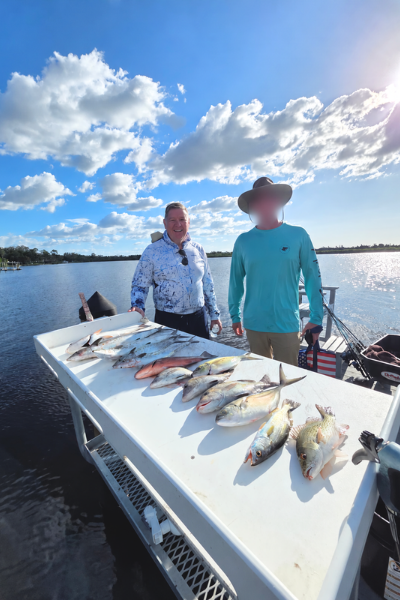 October is one of my favorite times of year to fish Tampa Bay. Cooler mornings, changing seasonal patterns, and an incredible variety of available species make fall fishing one of the most exciting times to get on the water.
However, October also brings stronger northeasterly winds, changing barometric pressure, and occasionally challenging water conditions.
Our latest Tampa Bay fishing charter on Saturday, October 24, 2026, provided a perfect example of how understanding tides, weather, feeding periods, and fish behavior can turn a challenging start into a successful eight-hour adventure.
We welcomed Adam and John aboard Salty Scales Fishing Charters for their first fishing experience in Tampa Bay. Their wives were attending a Christian conference at the Tampa Convention Center, giving the guys the perfect opportunity to spend the day fishing.
Our original plan was to head offshore, but the winds weren’t cooperating. Rather than battle rough conditions, we decided to spend eight hours exploring Tampa Bay, targeting redfish, snook, speckled trout, grouper, snapper, and whatever else wanted to bite.
By the time the day was over, we had caught an impressive variety of fish, completed an inshore slam, battled a monster redfish, and found productive action despite the less-than-ideal conditions.
Tampa Bay Weather Conditions – October 24, 2026
Before getting into the fishing action, it’s important to understand the weather conditions we faced.
A persistent northerly to northeasterly wind pattern had been affecting Tampa Bay, creating rougher conditions across exposed sections of the bay and leaving much of the water stained and murky.
The National Weather Service had issued a Small Craft Advisory for Tampa Bay waters, with its early Saturday marine forecast calling for northeast winds around 20 knots and gusts up to 25 knots.
Although conditions varied considerably depending on location and shoreline protection, this was enough to make our original offshore plans undesirable.
Historical Weather Observations
The following observations were recorded at Tampa International Airport, providing a useful regional comparison for the conditions we experienced on the water.
| Weather Factor | October 24 Conditions |
|---|---|
| High temperature | 82°F |
| Low temperature | 63°F |
| Wind direction | Primarily north to northeast |
| Recorded airport winds | Generally 7–15 mph during the charter |
| Recorded gusts | Approximately 20–21 mph at several observations |
| Morning barometric pressure | 30.16–30.17 inHg |
| Late-afternoon barometric pressure | Approximately 30.06 inHg |
| Relative humidity | Approximately 78% early, dropping into the low 40s during the afternoon |
| Rainfall | 0.00 inches recorded |
| Sky conditions | Mostly sunny and clear during the morning, with increasing clouds later |
| Sunrise | 7:35 a.m. |
| Sunset | 6:52 p.m. |
| Moon phase | Waxing gibbous, approximately 97% illuminated |
| Major solunar period | Approximately 10:54 a.m.–12:54 p.m. |
Airport measurements do not necessarily represent the wind speed directly on Tampa Bay, particularly in exposed areas where the wind has a long distance to travel across open water.
Hourly Temperature, Wind, and Barometric Pressure
| Time (EDT) | Temperature | Wind | Barometric pressure |
|---|---|---|---|
| 8:53 a.m. | 67°F | NNE, 7 mph | 30.16 inHg |
| 9:53 a.m. | 70°F | NE, 10 mph, gusting 21 mph | 30.17 inHg |
| 10:53 a.m. | 74°F | NNE, 13 mph | 30.16 inHg |
| 11:53 a.m. | 77°F | N, 13 mph | 30.15 inHg |
| 12:53 p.m. | 79°F | NNE, 8 mph | 30.13 inHg |
| 1:53 p.m. | 81°F | Variable, 7 mph, gusting 21 mph | 30.10 inHg |
| 2:53 p.m. | 81°F | N, 7 mph, gusting 20 mph | 30.08 inHg |
| 3:53 p.m. | 82°F | NNE, 9 mph | 30.07 inHg |
| 4:53 p.m. | 81°F | NNE, 10 mph, gusting 21 mph | 30.06 inHg |
These readings tell an interesting story.
We started the morning with relatively high barometric pressure, which increased slightly before reaching approximately 30.17 inches of mercury around 10 a.m.
From there, pressure gradually declined throughout the afternoon, dropping approximately 0.11 inHg by late afternoon.
That’s a noticeable change of roughly 3.7 millibars.
While barometric pressure alone doesn’t determine whether fish will bite, changes in pressure, wind direction, tidal movement, and light conditions can all influence the fishing environment.
On this particular day, the best inshore action began near the morning pressure peak and continued as the incoming tide gained strength.
The more important observation was the combination of moving water, suitable habitat, and the timing of the feeding window.
October 24 Tampa Bay Tides and Solunar Feeding Times
Tidal movement played an especially important role in Saturday’s charter.
A nearly full moon was approaching, and the tidal cycle created a substantial morning low tide followed by a strong incoming tide during the middle of the day.
Little Manatee River Tide Predictions
Tide timing varies depending on the station’s location. For example, the water turns earlier near Shell Point at the river mouth than it does farther upstream near the U.S. 41 bridge.
| Tide event | Shell Point | Little Manatee River at U.S. 41 |
|---|---|---|
| Early-morning high | 1:03 a.m. | 1:51 a.m. |
| Morning low | 7:50 a.m. | 8:54 a.m. |
| Afternoon high | 2:06 p.m. | 3:38 p.m. |
| Predicted morning low height | 0.4 ft | 0.1 ft |
| Predicted afternoon high height | 1.9 ft | 1.4 ft |
Heights are predictions relative to mean lower low water. Actual levels may differ because of wind and other environmental conditions.
This explains why there was so little water available when we began fishing.
Our 8:30 a.m. departure placed us near the bottom of the morning tidal cycle. With the persistent northeasterly winds also influencing water movement, some of the shallow areas were especially difficult to access.
Fortunately, the tide would begin building throughout the morning.
Major and Minor Feeding Periods
Saturday’s moon was approximately 97% illuminated, just two days before the October 26 full moon.
The predicted major solunar feeding window was approximately 10:54 a.m. to 12:54 p.m.
The afternoon minor period was around 5:15–6:15 p.m., near moonrise.
These solunar periods are predictions based on lunar position rather than guarantees of feeding activity, but they provide another useful factor when planning a trip.
Interestingly, we began getting consistent redfish action shortly before the major window, just as the incoming tide was beginning to push water into the mangrove habitat.
That overlap proved to be one of the most productive parts of our day.
A Late Start and the Challenge of Finding Live Bait
Because Adam and John had to drop their wives off at the convention center, we couldn’t depart at our typical early morning time.
Instead, we left the dock around 8:30 a.m.
By then, the winds were already noticeable, and Saturday boat traffic had picked up throughout the Little Manatee River.
Many anglers were staying in the river to escape the rougher conditions across the open bay.
Our first priority was securing enough live bait for the entire eight-hour fishing charter.
We headed toward one of my regular bait locations near a local fishing pier.
Unfortunately, several anglers were already fishing from the pier, making it difficult to position the boat without interfering with their lines.
Rather than disturb them, we headed toward a protected canal near Hooks, hoping to locate another school of pilchards.
The canal was sheltered from the wind, but despite searching the area, we couldn’t find the bait we needed.
We eventually returned to the pier and carefully positioned the boat away from the fishermen.
After introducing some chum, we managed to attract a good mixture of pilchards and pinfish.
Aiden quickly went to work with the cast net.
Approximately four throws later, our livewell was loaded with enough bait for an eight-hour day.
This was an important first victory because with the heavily stained water, having lively bait and plenty of chum would become a major part of our fishing strategy.
Fishing the Little Manatee River During Low Tide
With our bait secured, we began fishing near the mouth of the Little Manatee River.
Normally, I enjoy targeting the oyster bars and surrounding grass flats in this area, particularly when redfish and snook are feeding along the edges.
However, we were dealing with an extremely low tide.
We worked several oyster bars, deeper grass edges, and patches of water that looked promising.
Unfortunately, the fish weren’t cooperating.
Even though we were approaching the predicted major solunar period, the fish simply weren’t positioned where we initially expected them.
After spending some time searching without much action, I decided to change locations.
We had just enough water to navigate across one of the shallow flats and enter a protected deep-water canal that I’ve fished successfully for years.
This particular canal averages approximately five to eight feet deep and offers several important advantages.
The deeper water provides fish with a place to retreat during low tide, while nearby mangrove points, sandbars, and shoreline structure create excellent feeding opportunities when the current starts moving.
Once we cleared the shallow sandbar and entered the canal, I had a feeling things were about to improve.
There were quite a few bank fishermen lining the shoreline, so we carefully navigated around their fishing lines before reaching one of my favorite points.
Redfish Action Begins as Barometric Pressure Peaks
By approximately 10 a.m., the skies were sunny, the northeasterly wind was still blowing, and the incoming tide was beginning to push water toward the mangrove shoreline.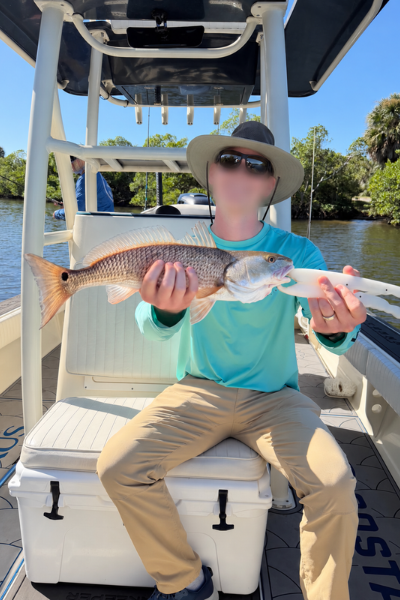
The barometric pressure was also near its morning peak of approximately 30.17 inHg.
We were approaching the predicted major feeding period, and the rising water was beginning to create more favorable conditions.
We positioned the boat near a productive mangrove point and started making presentations underneath the trees.
Our equipment consisted primarily of Okuma spinning tackle, including some of our Tavares spinning rod and reel combinations.
We mixed up our bait presentations, using shrimp, live pilchards, and threadfin herring.
I wanted to see whether the fish preferred a particular bait.
Almost immediately, John hooked up with a nice little redfish.
Moments later, Adam connected with another.
Before long, we had caught approximately five or six juvenile redfish, commonly called rat reds.
These fish weren’t giants, but they provided steady action and helped both anglers experience the excitement of Tampa Bay redfish fishing.
The incoming tide was allowing the fish to move closer to the mangrove structure, where food was becoming increasingly accessible.
This is an important pattern for anglers targeting redfish during periods of low water.
Fish that have been holding in deeper channels or depressions will often move toward shallower feeding areas as the tide rises.
After the initial flurry of action, the bite started slowing down, so we made another move.
And that’s when Adam hooked something substantially larger.
Adam Battles a Monster Redfish
We continued farther into the canal, working another series of points and deeper pockets.
By this time, the tidal current had begun slowing in parts of the canal, so we introduced additional chum to stimulate feeding activity.
It didn’t take long.
Adam hooked into a fish that immediately felt different.
This wasn’t another small redfish.
The fish pulled hard, putting the lighter spinning tackle to work.
We battled the fish for a while and estimated that it was approximately a 30-inch redfish.
At one point, we thought Adam had successfully pulled it away from the structure.
Unfortunately, just as things were looking promising, the hook pulled free.
The big fish was gone.
That’s one of the frustrating realities of light-tackle fishing.
You can do everything right and still lose a good fish.
Although we didn’t get the opportunity to measure or photograph that redfish, it provided one of the most exciting battles of the day.
Fortunately, we still had plenty of fishing left to do.
Snook, Trout, and Flounder Complete the Inshore Slam
Shortly after losing the oversized redfish, we connected with a respectable snook.
These fish are among my favorite species to target because of their aggressive feeding habits and powerful fighting ability.
Throughout the morning, Adam and John managed to catch several small- and medium-sized snook.
We continued fishing mangrove points and areas where the incoming tide created moving water.
The stronger northeasterly winds made exposed areas less comfortable, but the protected canal allowed us to fish effectively.
As we explored additional points, we began catching small flounder and speckled trout.
That officially completed the Tampa Bay inshore slam: redfish, snook, and spotted seatrout.
For Adam and John, who were both experiencing Tampa Bay fishing for the first time, this was a memorable accomplishment.
We continued working several productive points before returning toward some shallow mangrove habitat.
That final inshore move produced a couple more snook.
By this time, we had spent several hours targeting inshore gamefish and decided it was time to consider another change.
Fortunately, Mother Nature finally gave us a break.
An Unexpected Break in the Wind Opens Up Grouper and Snapper Fishing
Although the marine forecast called for persistent northeasterly winds, we experienced a noticeable improvement in conditions as the day progressed.
The wind diminished enough in our fishing area to comfortably explore some more exposed waters inside Tampa Bay.
Rather than continue working the mangroves, we decided to target some of my productive grouper and snapper locations.
This is one of the things that makes Tampa Bay such an incredible fishery.
You can spend the morning targeting redfish and snook in shallow water, then move into deeper structure and battle grouper, snapper, and other bottom-dwelling species.
We started fishing some familiar rock piles and immediately began getting bites.
Both gag grouper and red grouper were cooperating.
Several of the fish provided great fights on the spinning tackle.
We also hooked some substantially larger gag grouper that managed to escape before reaching the boat.
Anyone who has targeted gag grouper around rocky structure understands how powerful these fish can be.
They have an incredible ability to turn and head straight back toward cover, often leaving anglers with broken lines or lost fish.
We continued picking away at the grouper while also catching snapper and Key West grunts.
Adam and John managed to boat approximately three or four nice Key West grunts, along with a couple of legal snapper for the fish box.
They had hoped to take home some fresh fish, so putting a few quality fish in the cooler was another highlight.
After fishing several different rock piles, we decided to change our strategy one final time.
Spanish Mackerel Fishing in Stained Tampa Bay Water
For the last portion of our charter, we headed toward one of the towers inside Tampa Bay.
Our primary target was Spanish mackerel, although we also wanted to explore the bottom for sand trout and speckled trout.
The water conditions presented another challenge.
Persistent winds had left much of Tampa Bay extremely stained and murky.
Spanish mackerel are aggressive predators that often rely on sight when pursuing baitfish.
When water visibility is poor, it can be more difficult to attract their attention.
To overcome this, we began introducing a healthy amount of chum into the water.
We also experimented with two presentations.
One rod was rigged with a small split shot to position the pilchard slightly deeper.
The second rod was completely freelined, allowing the live bait to swim naturally without added weight.
Both setups were designed to present lively bait around the structure while we worked to bring the fish into feeding range.
We also deployed bottom presentations in hopes of locating sand trout and speckled trout.
It wasn’t long before the action picked up.
We connected with a few trout and approximately four or five nice Spanish mackerel.
Those mackerel provided some excellent late-day action and gave the guys another exciting species to add to their catch list.
Several of the Spanish mackerel would also make excellent fresh fillets.
The most important lesson from this portion of the trip was the value of chumming in stained water.
By repeatedly introducing bait into the area, we were able to help attract the attention of predators despite the challenging visibility.
Heading Back to the Little Manatee River
Before we knew it, our eight hours of fishing were coming to an end.
We had experienced changing wind conditions, an extremely low morning tide, rising water, fluctuating current, and a gradual decline in barometric pressure.
But by constantly adjusting our game plan, we managed to find productive fishing throughout the day.
We headed back into the calmer waters of the Little Manatee River and returned to the dock.
After securing the boat on the lift, Aiden went to work cleaning and filleting the fish Adam and John had kept.
Looking back, the day had plenty of highlights.
We caught multiple redfish, including the exciting battle with Adam’s estimated 30-inch fish that escaped.
We landed several snook, completed an inshore slam with speckled trout, caught flounder, battled gag and red grouper, and boated snapper, Key West grunts, and Spanish mackerel.
Most importantly, two anglers who had never experienced Tampa Bay fishing before enjoyed an exciting day on the water.
What We Learned About Tampa Bay Fishing Conditions
There were several important takeaways from this trip, particularly when evaluating the relationship between weather conditions, tides, and fish activity.
1. The Incoming Tide Was Critical
The morning low tide left little water covering many of our normal redfish and snook locations.
Once the incoming tide began flooding the mangrove shoreline, the fishing improved considerably.
The productive water wasn’t necessarily the shallowest water available, but the deeper areas positioned close to structure and incoming tidal flow.
2. The Major Solunar Period Aligned With Improved Fishing
Our first productive fishing location began producing fish around 10 a.m., just before the predicted major solunar period of approximately 10:54 a.m.–12:54 p.m.
This also coincided with the incoming tide.
While solunar tables don’t guarantee fish will feed, the overlap of current, habitat, and favorable timing certainly provided a useful opportunity.
3. Barometric Pressure Was High but Gradually Falling
The morning barometric pressure near 30.17 inHg indicated a relatively high-pressure environment.
Pressure gradually declined throughout the afternoon.
The change coincided with several phases of the fishing trip, although there is no way to establish that pressure alone was responsible for the bites.
For me, the most valuable information came from combining the pressure observations with actual fish activity, current movement, wind, and structure.
4. Wind Direction Influenced Our Location Choices
The northeasterly wind made certain open-water areas uncomfortable while leaving portions of the Little Manatee River and protected canal system more fishable.
Finding protected water made it possible to continue fishing comfortably without sacrificing opportunities to catch quality fish.
5. Dirty Water Made Live Bait and Chumming More Important
The stained water made fishing more challenging, particularly when targeting Spanish mackerel.
Fresh live bait and aggressive chumming helped us generate bites when visibility was limited.
6. Flexibility Made the Difference
We started with plans to fish offshore, transitioned to inshore fishing, then moved to grouper and snapper structure before finishing with Spanish mackerel.
Being willing to adjust throughout the day gave Adam and John an opportunity to experience an incredible variety of Tampa Bay species.
Late October Tampa Bay Fishing Outlook
As we continue moving through October and into November, I expect Tampa Bay to offer some excellent fall fishing opportunities whenever weather conditions allow.
Redfish and snook should continue offering opportunities around protected mangrove shorelines, oyster bars, tidal creeks, and deeper channels.
Speckled trout remain an excellent target around grass flats and deeper edges, while rocky bottom and hard structure provide opportunities for grouper, snapper, and grunts.
Spanish mackerel can provide exciting action around bait schools, towers, and channel structure.
The biggest thing I’m looking forward to right now is improved water clarity.
Persistent winds have left much of Tampa Bay heavily stained, and I’d love to see the water settle down and clear up.
Once calmer conditions return, improved visibility should make locating fish and identifying active bait schools easier.
Nevertheless, even with challenging winds and dirty water, the overall bite has been pretty good.
Saturday’s trip was another reminder that you don’t need perfect weather to enjoy excellent fishing.
You need a solid game plan, the willingness to adapt, and an understanding of how fish respond to changing conditions.
Book Your Tampa Bay Fishing Charter With Salty Scales
If you’re looking to experience some of the best fishing Tampa Bay has to offer, fall is an excellent time to schedule your trip.
Whether you’re visiting the Tampa area for a convention, enjoying a family vacation, or simply looking for an unforgettable fishing adventure, we would love to welcome you aboard.
At Salty Scales Fishing Charters, we offer four-, six-, and eight-hour fishing adventures targeting a wide variety of Tampa Bay species.
With more than 30 years of local fishing experience, Captain Joshua Taylor works to build every charter around the conditions and opportunities available that day.
Visit SaltyScalesCharter.com to learn more or reserve your next Tampa Bay fishing charter.
The fall weather is fantastic, the fish are biting, and we’re looking forward to another exciting season on the water.
Tight lines!
Captain Joshua Taylor
Salty Scales Fishing Charters
Tampa Bay, Florida