 Skip to content

Tampa Bay Fishing Report October 21 2026 | South Tampa Bay Fishing Chronicles | Capt. Joshua Taylor – Salty Scales Fishing Charters
Strong northeasterly winds, dirty water, and high barometric pressure made fishing challenging, but persistence and the right bait helped us put some beautiful Tampa Bay redfish in the boat.
A Challenging Morning With the Perry Homes Crew
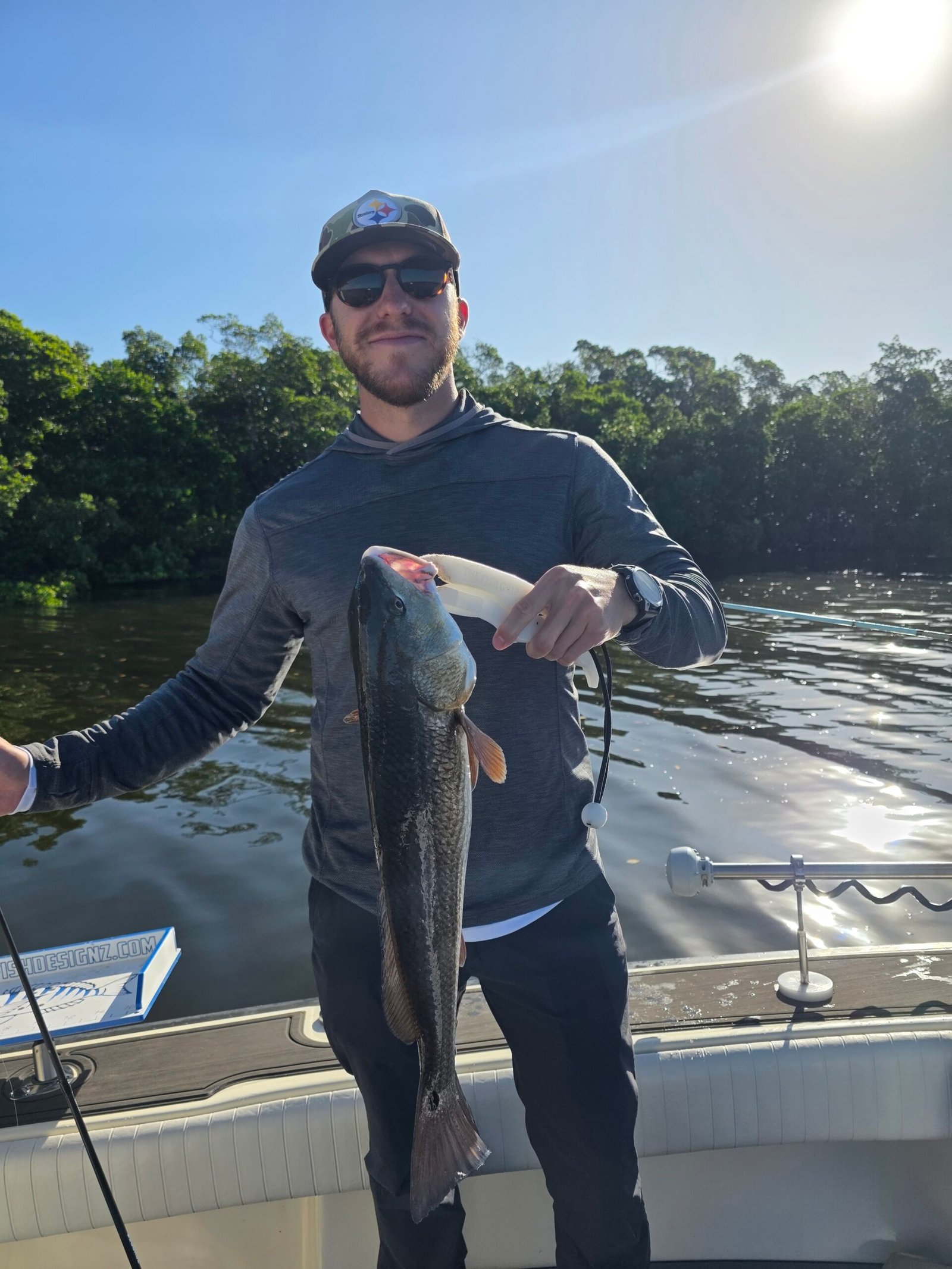 After more than 30 years of fishing Tampa Bay, I’ve learned that Mother Nature doesn’t always cooperate with our plans. Some days, everything lines up perfectly: beautiful weather, clean water, plenty of bait, and fish that seem willing to eat anything you throw at them.
Then there are days like today.
Wednesday, October 21, 2026, presented a completely different challenge. We were dealing with the aftermath of a passing cold front, elevated barometric pressure, strong north-northeasterly winds, and water clarity that left plenty to be desired.
Nevertheless, we had fish to catch and a great group of guys ready to experience some Tampa Bay inshore fishing.
Mike, with Perry Homes, had reached out to me about organizing a fishing trip for several gentlemen from different parts of Central Florida.
We decided on a four-hour inshore fishing charter departing from Ruskin, Florida.
I explained beforehand that the wind wasn’t going to be particularly favorable. However, I also knew that we had a decent incoming tide during the morning and an opportunity to capitalize on a major feeding period.
As a fishing guide, I’ve learned that understanding how fish respond to changing conditions is often more valuable than waiting for perfect weather.
And today would prove that point.
Tampa Bay Weather Conditions: October 21, 2026
Before diving into the fishing action, it’s important to understand the conditions we faced.
A cold front had moved through the Tampa Bay region, bringing northerly winds and cooler morning temperatures.
The wind had also been stirring up the bay for several days, significantly reducing water visibility.
Here is a breakdown of the conditions during our charter.
| Weather Factor | October 21 Conditions |
|---|---|
| Departure time | 7:30 a.m. |
| Air temperature at 7 a.m. | 62°F |
| Air temperature at 11 a.m. | 75°F |
| Wind direction | North to north-northeast |
| Airport wind observations | Approximately 5–10 mph during our trip |
| Conditions on open Tampa Bay | Roughly 2–3-foot chop, observed from the boat |
| Barometric pressure | Approximately 30.07–30.10 inHg during the morning |
| Water temperature | Approximately 75°F, estimated during the charter |
| Water clarity | Poor, with significant wind-driven turbidity |
| Morning low tide, Cockroach Bay | 5:34 a.m. |
| Morning high tide, Cockroach Bay | 10:35 a.m. |
| High tide height | Approximately 1.5 feet above MLLW |
The National Weather Service recorded northerly winds and barometric pressure climbing from approximately 30.07 inches at 7 a.m. to 30.10 inches at 11 a.m. at Tampa International Airport. These are land-based observations; wind and wave conditions varied considerably across the bay. NOAA FTP
Tide predictions for Cockroach Bay placed the morning high tide at approximately 10:35 a.m., giving us an incoming tide throughout much of the charter. Navit
How High Barometric Pressure Affects Tampa Bay Fishing
One of the biggest challenges following a cold front is the adjustment fish make to changing environmental conditions.
Post-frontal weather often brings cooler temperatures, shifting winds, and rising atmospheric pressure.
Today’s barometer was hovering around 30.1 inches, which was consistent with the high-pressure conditions we were experiencing.
While barometric pressure alone doesn’t determine whether fish feed, the combination of frontal changes, wind, water temperature, and reduced visibility can certainly complicate the bite.
I’ve experienced plenty of situations where fish become less aggressive immediately following a front.
Instead of chasing bait over long distances, they’ll often hold tighter to structure and become more selective.
That’s why I wanted to concentrate on mangrove shorelines where redfish could take advantage of the rising water.
We also had a major feeding period working in our favor.
Even when conditions aren’t ideal, moving water and favorable feeding windows can make all the difference.
Catching Live Bait Was the First Major Challenge
We left the dock at approximately 7:30 a.m.
Fortunately, I had already made an important decision before the charter.
Knowing that baitfish might be difficult to locate, I asked my wife, Stephanie, to pick up approximately three dozen large live shrimp.
That decision would ultimately pay off.
By 7:45 a.m., we had reached the flats where I intended to catch our live bait.
Unfortunately, the conditions were exactly what I had anticipated.
Strong northerly winds were blowing across the bay, producing an uncomfortable chop.
Water visibility was extremely limited.
We moved into approximately 2½ to 3 feet of water, where I began chumming with Purina tropical fish food.
My setup consisted of a 3/16-inch mesh dropout cast net weighing approximately 1½ pounds per foot.
Normally, when bait is plentiful, a few well-placed throws can provide more than enough pilchards for a four-hour charter.
Not today!
After a considerable amount of chumming and no fewer than a dozen cast-net throws, I managed to collect roughly 50 baitfish consisting primarily of pilchards and smaller pinfish.
It was work.
And considering we had a productive incoming tide approaching, I didn’t want to spend the entire morning catching bait.
Sometimes, as a charter captain, you have to decide when enough is enough.
We had some live bait, several dozen shrimp, and a plan.
It was time to head south.
South Tampa Bay Redfish: First Stop Produces a Beautiful 25-Incher
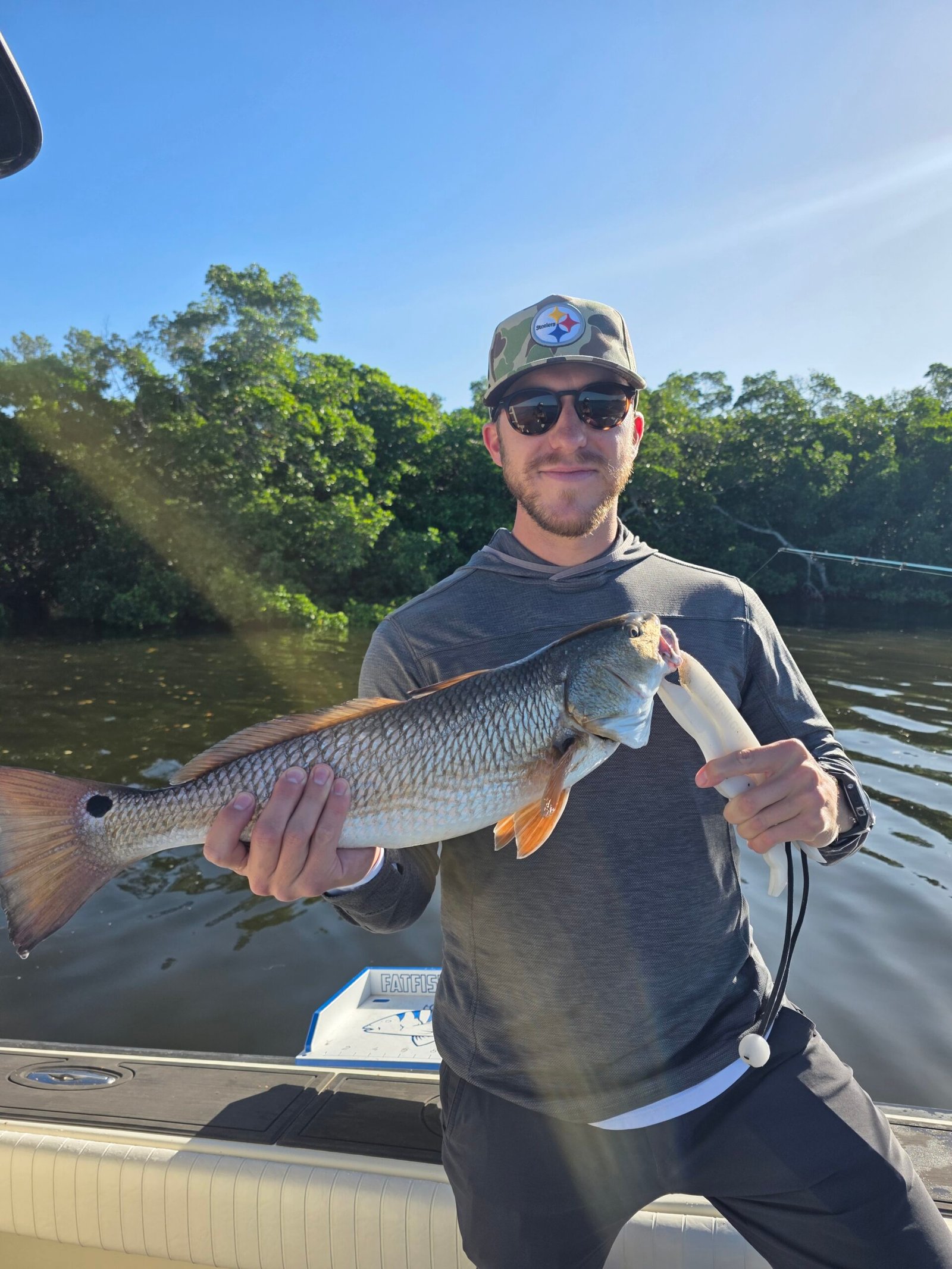 We headed toward some of my favorite mangrove shorelines in southern Tampa Bay.
With the incoming tide pushing water into the trees, I knew redfish would have opportunities to move farther into the mangrove roots to feed.
Our first stop didn’t disappoint.
Almost immediately, we hooked into a beautiful redfish measuring approximately 25 inches.
What a way to start!
The fish fought hard, and after a short battle, we brought it aboard.
There’s something special about seeing a healthy Tampa Bay redfish come over the gunwale, especially when the morning conditions have been less than favorable.
But the action was just getting started.
A Big Fish Breaks Chris Off in the Mangroves
On the very next cast, Chris pitched his bait deep into the mangrove bushes.
Within seconds, his line came tight.
Something substantial had inhaled the bait.
Chris was fishing one of the new Okuma spinning reels, and the fish immediately put the equipment to work.
Unfortunately, the redfish gained a little too much ground.
Anyone who regularly targets mangrove redfish knows exactly what happens when a powerful fish gets too deep into the roots.
The line finds structure, and just like that, the fish wins.
Chris got broken off.
Although losing a quality fish is always frustrating, the encounter confirmed something important.
The redfish were actively feeding despite the difficult post-frontal conditions.
That was encouraging.
Live Shrimp Under a Popping Cork Produces Another Redfish
We continued working the same mangrove pocket.
One of the other gentlemen made a cast with a popping cork and a large, lively shrimp.
The cork settled near the mangroves.
It wasn’t long before another redfish decided to eat.
Although this fish was smaller than our first, it was another welcome addition to the morning’s action.
We continued fishing the area, producing several fish before something unexpected happened.
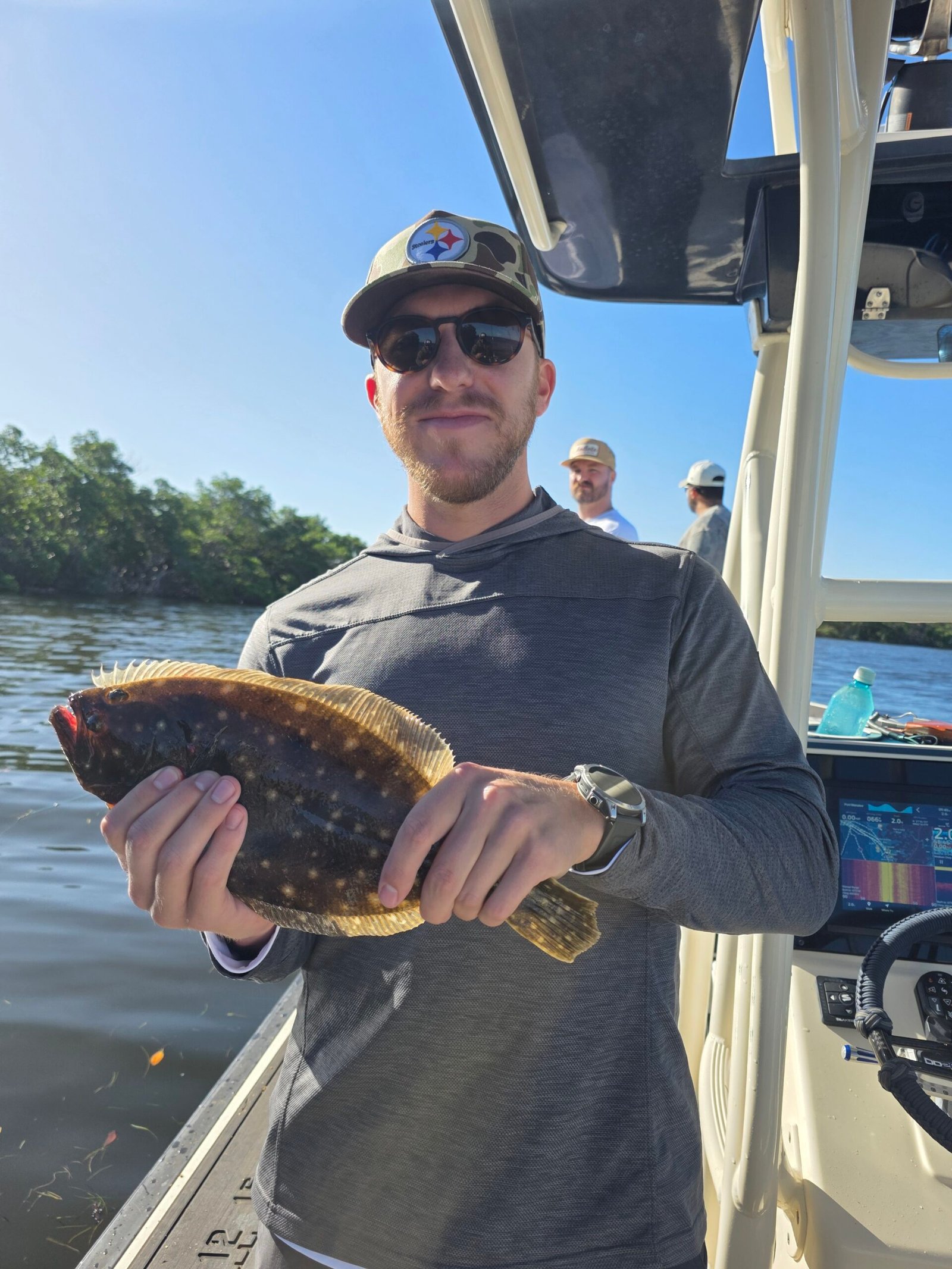
A beautiful flounder decided to join the party.
And what did it eat?
A live shrimp beneath a popping cork!
Flounder aren’t necessarily the first species that comes to mind when fishing shrimp under a cork near mangroves, but these opportunistic predators will certainly take advantage of an easy meal.
After approximately four or five fish from our first location, I decided it was time to explore another area.
The morning was shaping up nicely, especially considering the conditions we had faced.
Finding the Right Bait: Pilchards and Small Pinfish Were the Winners
Our second stop was considerably less productive.
One of the things I like to do when fishing difficult conditions is experiment with different bait presentations.
Just because a fish isn’t eating one particular bait doesn’t necessarily mean it isn’t hungry.
Throughout the morning, I rotated between several options:
- Live pilchards
- Small pinfish
- Large live shrimp
- Threadfin herring
My goal was to determine what the redfish were most interested in eating.
Although shrimp produced some quality action earlier, pilchards and smaller pinfish seemed to be the preferred offerings throughout much of the morning.
That wasn’t particularly surprising.
Redfish are opportunistic feeders, and smaller baitfish are often an important part of their diet throughout Tampa Bay.
However, the fish weren’t feeding everywhere.
After approximately 20 minutes without producing another fish, I realized I had probably stayed at that particular location longer than necessary.
That’s something even experienced guides occasionally do.
You know fish should be there, the habitat looks right, and the tide is moving.
But sometimes, the fish simply aren’t cooperating.
Rather than continue waiting, we moved to another mangrove point.
That decision paid off almost immediately.
Another Quality Redfish and a Productive Incoming Tide
 After repositioning the boat, we began working another shoreline where the incoming tide was providing additional access to the mangroves.
It wasn’t long before another quality redfish inhaled one of our baits.
Fish on!
After another exciting fight, we slid the net underneath a beautiful redfish.
We brought the fish aboard, took some photographs, and celebrated another successful catch.
At this point, we had caught enough redfish to satisfy our intended harvest for the day.
With the redfish cooperating, I decided to switch things up.
We still had time remaining on our charter, and I wanted the guys to experience some different species.
Our next destination was a nearby trout flat.
Tampa Bay Trout Fishing: Dirty Water Makes Things Difficult
One of the biggest problems we faced throughout the morning was water clarity.
The sustained winds associated with the passing front had churned up much of Tampa Bay.
While redfish can feed effectively in stained water, spotted seatrout can become more challenging to locate when visibility deteriorates.
I wasn’t particularly confident about the trout bite, but I wanted to give it a shot.
Once we arrived, we began experimenting with different bait presentations.
We deployed live bait and even worked some artificial lures.
One of the gentlemen was fishing a Z-Man artificial lure, hopping it along the bottom in hopes of enticing a trout.
Eventually, he connected with a smaller spotted seatrout.
We also caught a ladyfish, which we saved for future cut bait.
Unfortunately, the larger trout never materialized.
What did show up were Spanish mackerel.
Or at least their teeth!
We experienced several frustrating bite-offs while fishing the flat.
Anyone familiar with Spanish mackerel understands how quickly their razor-sharp teeth can slice through conventional monofilament or fluorocarbon leaders.
Although the mackerel weren’t our intended target, their presence gave me an idea.
Looking for Spanish Mackerel Around Structure
At this point, conditions across the open bay were getting uncomfortable.
We were dealing with approximately two- to three-foot chop in some exposed areas.
Still, I wanted to see whether we could capitalize on the Spanish mackerel activity we had encountered.
I figured that if mackerel were actively feeding over the grass flats, there might be a concentration of fish around a nearby tower.
These structures can attract baitfish, which in turn draw predators such as Spanish mackerel, blue runners, and other species.
We made the run and began fishing.
Unfortunately, the action wasn’t what I had hoped.
We experienced another bite-off, landed a blue runner, and caught a couple of bottom fish.
Nothing particularly exciting.
Rather than continue fighting the rough conditions, I decided to head back toward the Little Manatee River.
We still had one more opportunity to finish the trip on a positive note.
Little Manatee River Redfish Save the Final Stretch
As we worked our way into the Little Manatee River, we began targeting redfish holding along the bottom.
By this point, we had a pretty good understanding of which baits were producing.
Once again, pilchards and smaller pinfish were our primary offerings.
And sure enough, we managed to connect with a couple more redfish.
It was a fitting way to wrap up a challenging four-hour charter.
We had dealt with tough bait conditions, dirty water, strong winds, and an inconsistent bite.
We had also lost several quality fish throughout the morning, including some substantial break-offs.
But despite those setbacks, we managed to put together a respectable day of fishing.
And more importantly, everyone had a great time.
The Captain’s Takeaway: What Made the Difference?
Reflecting on today’s Tampa Bay fishing charter, there were several important lessons worth sharing.
1. Always Have a Backup Bait Plan
Having Stephanie pick up three dozen live shrimp was one of the smartest decisions I made that morning.
With live pilchards difficult to catch, the shrimp gave us another reliable option.
They ultimately produced redfish and a beautiful flounder.
Whether you’re fishing Tampa Bay professionally or recreationally, having multiple bait options can make a tremendous difference.
2. Don’t Overlook the Importance of Moving Water
Although the post-frontal conditions complicated the fishing, our incoming tide helped create opportunities.
The predicted 10:35 a.m. high tide provided enough water for redfish to access mangrove shorelines that would have been less productive during lower stages of the tide.
The strongest redfish action occurred around areas with moving water and nearby structure.
That’s something I consistently emphasize when targeting redfish throughout southern Tampa Bay.
3. High Pressure Doesn’t Mean Fish Won’t Eat
With the barometer hovering around 30.1 inches, conditions weren’t what I would consider ideal.
However, we still caught multiple quality redfish.
The key was finding fish in areas where they were comfortable feeding.
Rather than relying entirely on weather forecasts or barometric readings, anglers should consider the complete picture.
Water temperature, tidal movement, wind direction, bait availability, and structure all play important roles.
4. Know When to Move
One of the biggest lessons from today’s trip was knowing when to abandon an unproductive location.
Our first spot produced almost immediately.
Our second location was considerably slower.
After approximately 20 minutes without success, we moved and promptly connected with another redfish.
Sometimes, a small change in location makes all the difference.
5. Adapt Your Target Species to the Conditions
We began the day primarily targeting redfish.
From there, we experimented with trout, Spanish mackerel, and other species.
While some of those efforts weren’t particularly productive, they helped us determine what was happening throughout the bay.
Being flexible is essential when fishing changing conditions.
From the Fishing Boat to the Dinner Table: Hooks Waterfront Bar & Grill
One of my favorite parts of running fishing charters is seeing guests enjoy the rewards of their efforts.
After returning to the dock, I cleaned the beautiful redfish the gentlemen had caught.
But instead of taking their fish home to prepare later, the Perry Homes crew decided to enjoy their catch immediately.
They headed over to Hooks Waterfront Bar & Grill in Ruskin, where guests can have their freshly caught fish prepared for a meal.
Hooks offers a convenient cook-your-catch option for anglers returning from local fishing charters, subject to the restaurant’s current policies and preparation options. Tripadvisor
It’s a fantastic way to end a day on the water.
You spend the morning catching fish, enjoy some time with friends, and then sit down to a freshly prepared seafood meal.
It doesn’t get much better than that!
I also want to thank Mike and the entire Perry Homes group for choosing Salty Scales Fishing Charters.
The guys were an absolute pleasure to have aboard.
We shared some laughs, experienced some exciting battles, and lost a few fish that I’m sure we’ll be talking about for a while.
Hopefully, we’ll have another opportunity to do it again soon.
October Tampa Bay Fishing Forecast: What Anglers Should Expect
As we continue moving through October, Tampa Bay anglers can expect changing weather patterns to play an increasingly important role.
Fall cold fronts bring fluctuating temperatures and shifting winds that can significantly affect fishing conditions.
However, October is also an excellent time to target redfish, snook, spotted seatrout, and other popular inshore species.
Based on today’s experience, I would encourage anglers to concentrate on protected mangrove shorelines, particularly when strong northerly winds make exposed flats difficult to fish.
Live pilchards and smaller pinfish remain excellent options for redfish.
However, don’t overlook live shrimp, especially when baitfish become difficult to catch.
As water temperatures continue to respond to passing fronts, it’s also worth paying attention to sheltered areas where conditions may be more stable.
Most importantly, plan your fishing around productive tidal movement rather than relying solely on the weather.
Even on challenging days, Tampa Bay offers some outstanding fishing opportunities.
Book Your Tampa Bay Fishing Charter With Salty Scales
Whether you’re visiting the Tampa Bay area, organizing a corporate outing, or simply looking to spend a memorable day on the water, we’d love to have you aboard.
At Salty Scales Fishing Charters, we specialize in providing personalized fishing experiences throughout Tampa Bay, including Ruskin, Apollo Beach, St. Petersburg, and the surrounding waters.
From chasing redfish through the mangroves to targeting snook, trout, and other exciting species, every trip is an opportunity to experience what makes Tampa Bay such a special fishery.
With more than three decades of local fishing experience, my goal is simple: provide an enjoyable, educational, and productive day on the water.
And as today’s Perry Homes charter demonstrated, sometimes the most memorable fishing experiences happen when Mother Nature makes you work a little harder.
Tight lines, and God bless!
Capt. Joshua Taylor
Salty Scales Fishing Charters
www.SaltyScalesCharter.com