 Skip to content
Tampa Bay offshore fall fishing offers some of the best action of the year
Tampa Bay offshore fishing report: Monday, September 28, 2026, turned into one of those offshore Tampa Bay fishing trips that remind you why fall is such an exciting time to fish Florida’s Gulf Coast.
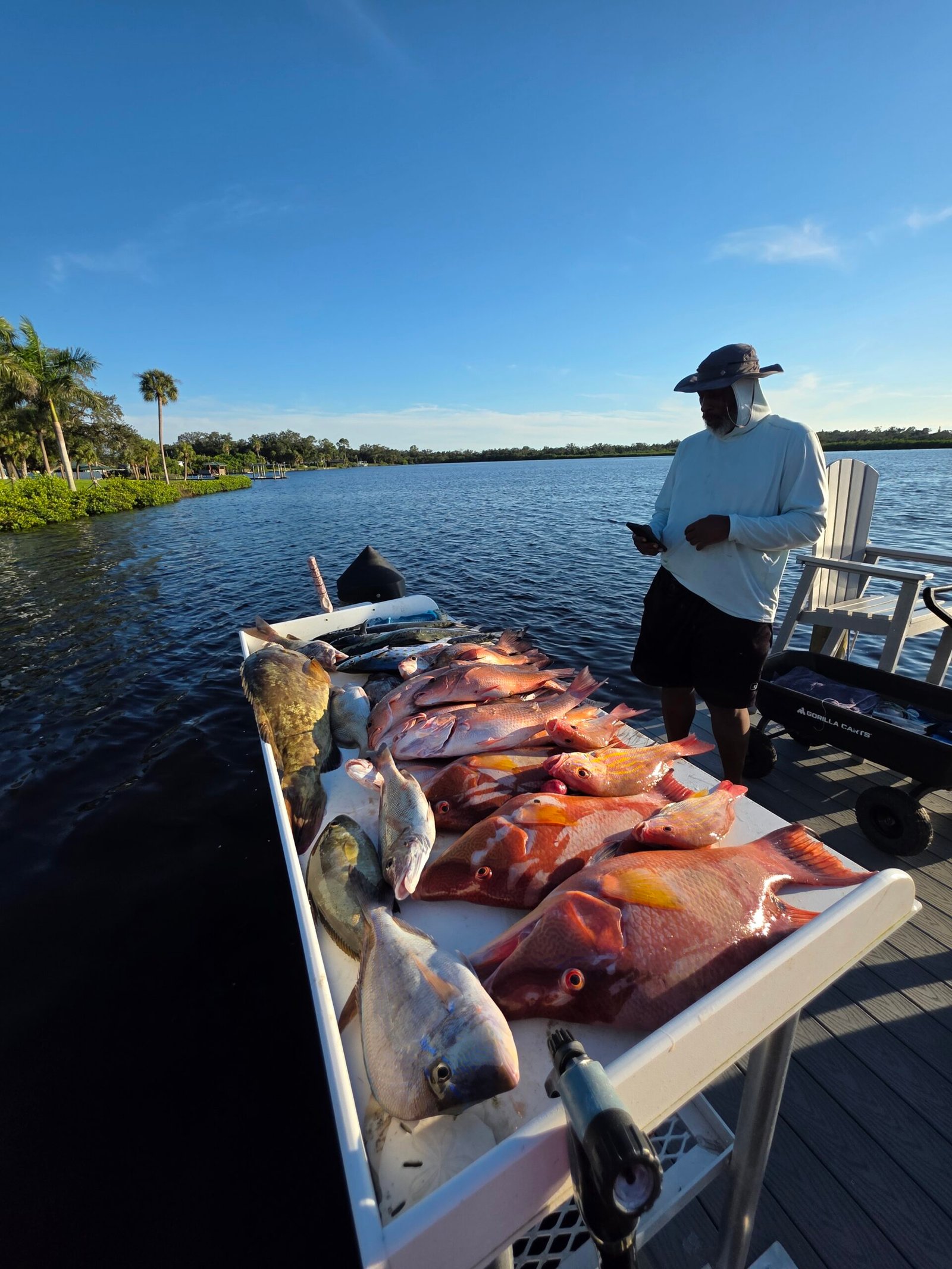
We had everything from a nearly glass-calm Gulf and an aggressive mangrove snapper bite to lane snapper, scamp grouper, a beautiful 30-inch gag grouper, several quality hogfish, and Spanish mackerel cruising around the boat.
More importantly, the trip provided several good lessons about finding offshore structure, matching tackle to the species, paying attention to feeding periods, and making sure you bring enough live bait when the grouper bite turns on.
We left the Little Manatee River area around 6:00 a.m. and headed toward the Port Manatee flats to load the livewell before making the long run offshore.
Loading the Livewell Before Running Offshore
 When I know we’re making a 25-plus-mile run into the Gulf, I want as much bait diversity as possible.
At Port Manatee, we used both the Sabiki and cast net to put together a mixture of pilchards, pinfish, and threadfin herring.
That combination gives you options once you get offshore.
Pilchards are outstanding for mangrove snapper and can also produce grouper, while pinfish and pigfish are some of my favorite larger grouper baits. Threadfins provide another natural bait that offshore predators are accustomed to seeing.
As we would discover later in the trip, though, we should have spent even more time loading up on larger pinfish and pigfish.
That ended up being probably the biggest lesson of the day.
Exploring New Offshore Bottom With CMOR Mapping
This wasn’t a typical charter where the entire game plan was built around spots I already knew.
My mate Jesse had been looking over some CMOR Mapping charts and wanted to explore several pieces of offshore bottom and ledges that looked promising. CMOR’s West Florida mapping includes Tampa-area structure and pipeline coverage extending offshore, which makes it useful for identifying the subtle ledges, rubble, and bottom changes that can hold fish.
We entered several areas into my electronics and started exploring.
Our original run put us in approximately 90 feet of water, roughly 25 to 27 miles offshore from the Egmont area.
The first piece of bottom looked promising, but the fish weren’t exactly what we were looking for.
We immediately began catching red grouper, but most were only around 12 to 15 inches.
That’s part of offshore fishing.
A spot can be absolutely covered in fish without holding the quality you’re looking for. Rather than spend the morning sorting through undersized grouper, we pulled the lines and continued searching.
Moving to the Pipeline Changed the Trip
 We eventually moved toward the pipeline and started looking around 80 feet of water.
That’s where things got interesting.
I found a nice rubble pile on the sonar that was marking quite a few fish.
Based on how the fish were relating to the structure and how they appeared on the screen, they looked like snapper.
We dropped down and found out quickly that our read was right.
For this part of the trip, we stayed relatively light.
We were fishing medium-heavy Salty Scales SRT rods paired with Okuma Cedros 4000 and Okuma Tesoro 4000 spinning reels.
The setup consisted of approximately 15-pound PowerPro main line, 20-pound leader, a 1-ounce weight, and a 1/0 hook fished as a small knocker rig.
That’s a very effective setup when you’re targeting mangrove snapper around offshore structure but still want enough backbone to deal with grouper and other fish that show up.
We sent pilchards and other small live baits to the bottom.
The response was almost immediate.
Mangrove Snapper Started Chewing
Mangrove snapper began coming over the rail almost immediately.
We also started experimenting with frozen shrimp because I wanted to see what else might be mixed into the structure. When you’re fishing good offshore bottom, changing bait can reveal species that may not be as aggressive toward larger live offerings.
Sure enough, the lane snapper started showing up.
One after another, we began adding quality table fish to the box while continuing to concentrate heavily on the mangrove snapper.
Before long, we had nearly put together a three-man limit of mangroves from that general area.
What made the bite even more interesting was the timing.
The conditions offshore were beautiful. Wind was almost nonexistent—around 2 mph by our observation—and the Gulf was extremely calm.
We had also just come through a front that brought a welcome taste of fall to Tampa Bay. Air temperatures had dropped several degrees compared with the previous stretch of hot weather, and we noticed the water temperature had backed down slightly as well.
That little temperature change can make a difference this time of year.
The snapper bite really came alive around the morning minor feeding period.
At Egmont Key, the September 28 tide bottomed out around 7:23 a.m. at approximately -0.2 feet and then climbed toward a 1:51 p.m. high around 1.8 feet, meaning we had incoming water building through much of the productive morning period.
That’s exactly why I tell anglers not to look at just one variable.
Moon phase matters. Majors and minors matter. Tide matters. Current matters. Weather matters.
But when several of those pieces overlap, you can sometimes see the fish respond very clearly.
A Surprise Scamp Grouper
 We continued moving among rock piles and pieces of structure around the pipeline, picking away at snapper.
Then Jesse hooked another fish.
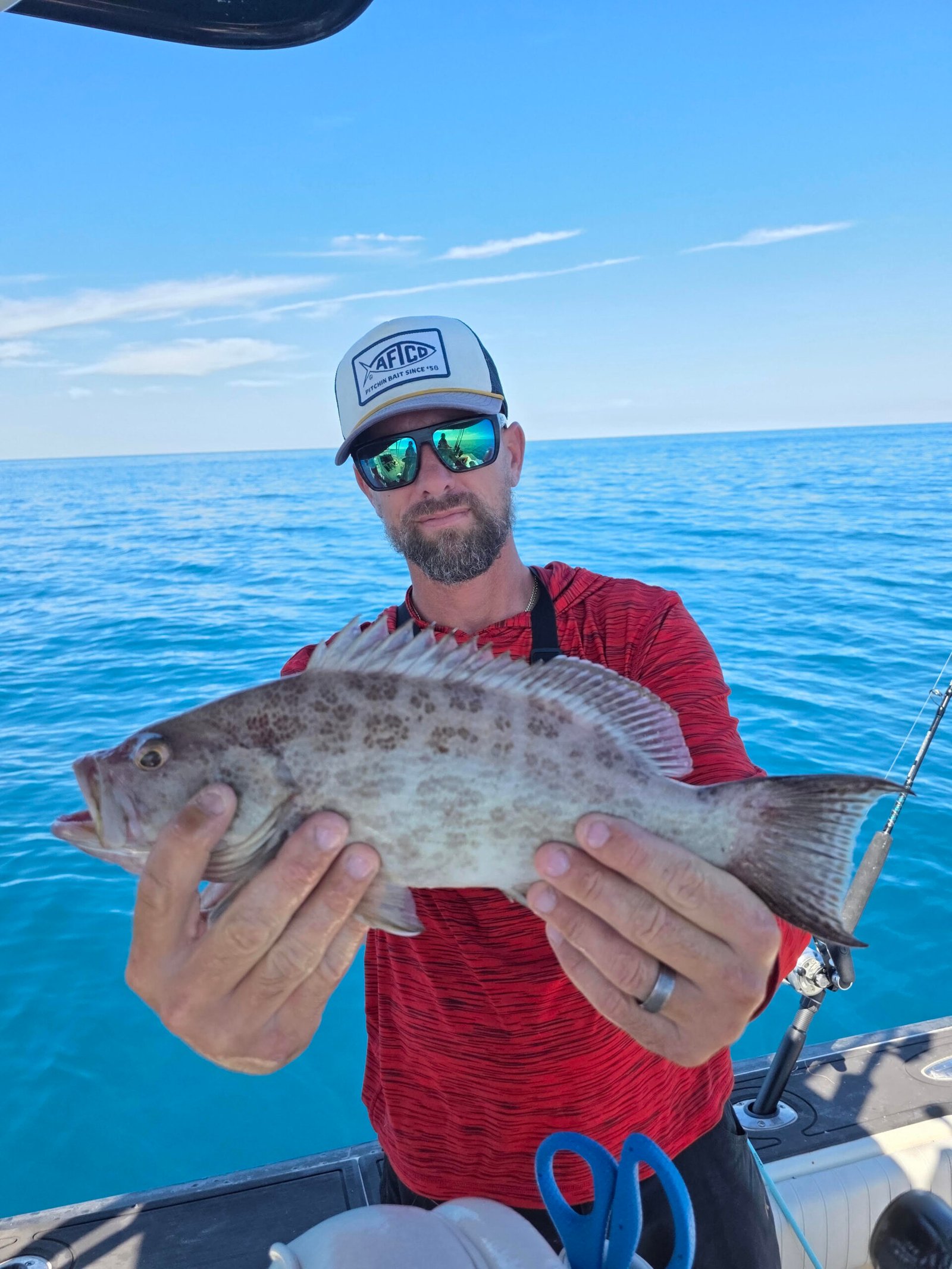
Up came a beautiful 16-inch scamp grouper.
It wasn’t a giant, but seeing a scamp in that 80- to 90-foot depth range was a nice surprise and added yet another species to an already diverse morning.
As the day progressed, however, I started thinking about the afternoon feeding window.
We knew a major was approaching, and rather than staying in the deeper water, I wanted to begin working our way back toward some of my proven hogfish and gag grouper areas.
So we started hopping spots on the way in.
We picked up more white grunts, a few additional snapper and other reef fish, but I had a particular destination in mind.
A place I call Hog Heaven.
One Big Pigfish—and Bird’s First Keeper Gag Grouper
Hog Heaven is one of my favorite hogfish areas, but it also has a couple of ledges that can hold some serious gag grouper.
That’s exactly what happened.
Bird grabbed the heavy spinning setup: an Okuma Tesoro 8000 paired with a PCH Custom rod, 50-pound main line, and 50-pound leader.
For bait, he hooked on a big live pigfish.
That pigfish barely reached the bottom.
The rod loaded up, and Bird was immediately connected to a serious fish.
Gag grouper around structure don’t give you much time to think. Once they eat, they’re looking for the nearest rock, ledge, or hole, and the first several seconds usually determine whether you’re going to win or lose.
Bird stayed on him through a short but intense battle.
Then we saw the fish coming up.
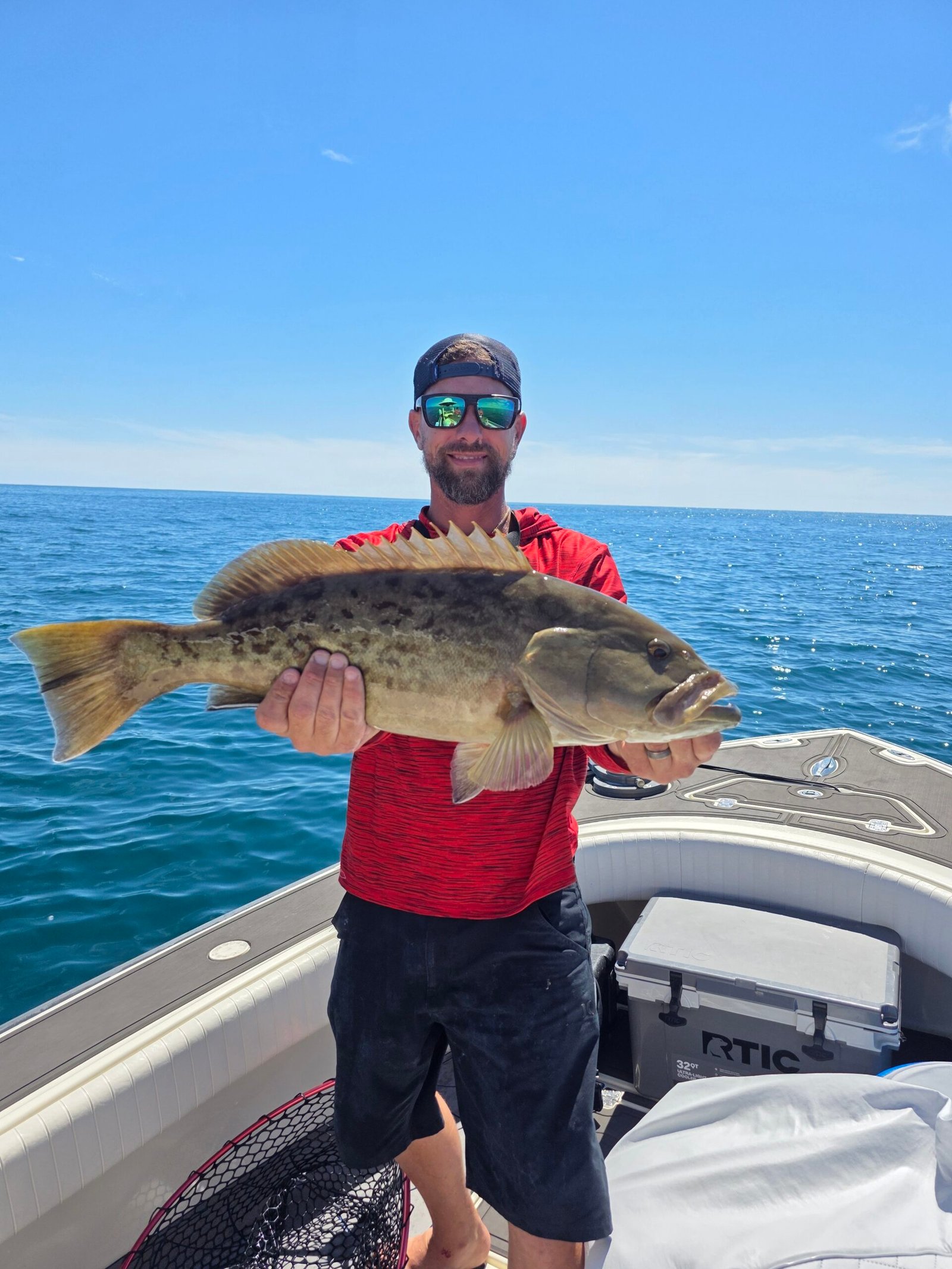
A beautiful 30-inch gag grouper surfaced beside the boat.
What made the fish even better was that Bird had never landed a keeper-size grouper before. He’d hooked quality grouper in the past, but somehow the bigger ones had always gotten the best of him.
Not this time.
We grabbed some pictures, celebrated the fish, and put that beautiful gag into the Yeti.
The timing was especially satisfying because September 28 fell within Florida’s September 1–30, 2026 Gulf gag grouper season.
Then Bird did something that made the story even better.
He reused the same pigfish.
Back down it went.
And he hooked another grouper.
This time a red grouper came over the side measuring 19¾ inches—just shy of keeper size.
One bait had almost produced two legal groupers.
The Biggest Mistake We Made: Not Enough Big Bait
This is where the trip turned into a valuable lesson.
We hadn’t caught enough pinfish and pigfish.
As the major feeding period arrived, the grouper began chewing, and we started going through large live baits far faster than I expected.
And these weren’t all small fish.
We got absolutely worked over another three times by big gag grouper.
Anyone who regularly targets gags knows exactly how quickly this can happen. You drop a bait toward a ledge, the fish eats, the rod loads—and if that grouper gets its head turned toward the structure for even a second, the battle can be over.
We had the fish.
We had the feeding period.
We had the spots.
What we were starting to run short on was the bait they wanted most.
If I were fishing the same trip again, I would spend additional time in the morning putting more pinfish and pigfish into the livewell before heading offshore.
Sometimes an extra 20 or 30 minutes catching bait early in the morning can pay for itself many times over when the major feeding period arrives.
A 23-Inch Hogfish on Shrimp
While Bird and Jesse were concentrating on grouper, I started fishing shrimp and looking specifically for hogfish.
It didn’t take long.
I hooked into a fish that immediately felt different.
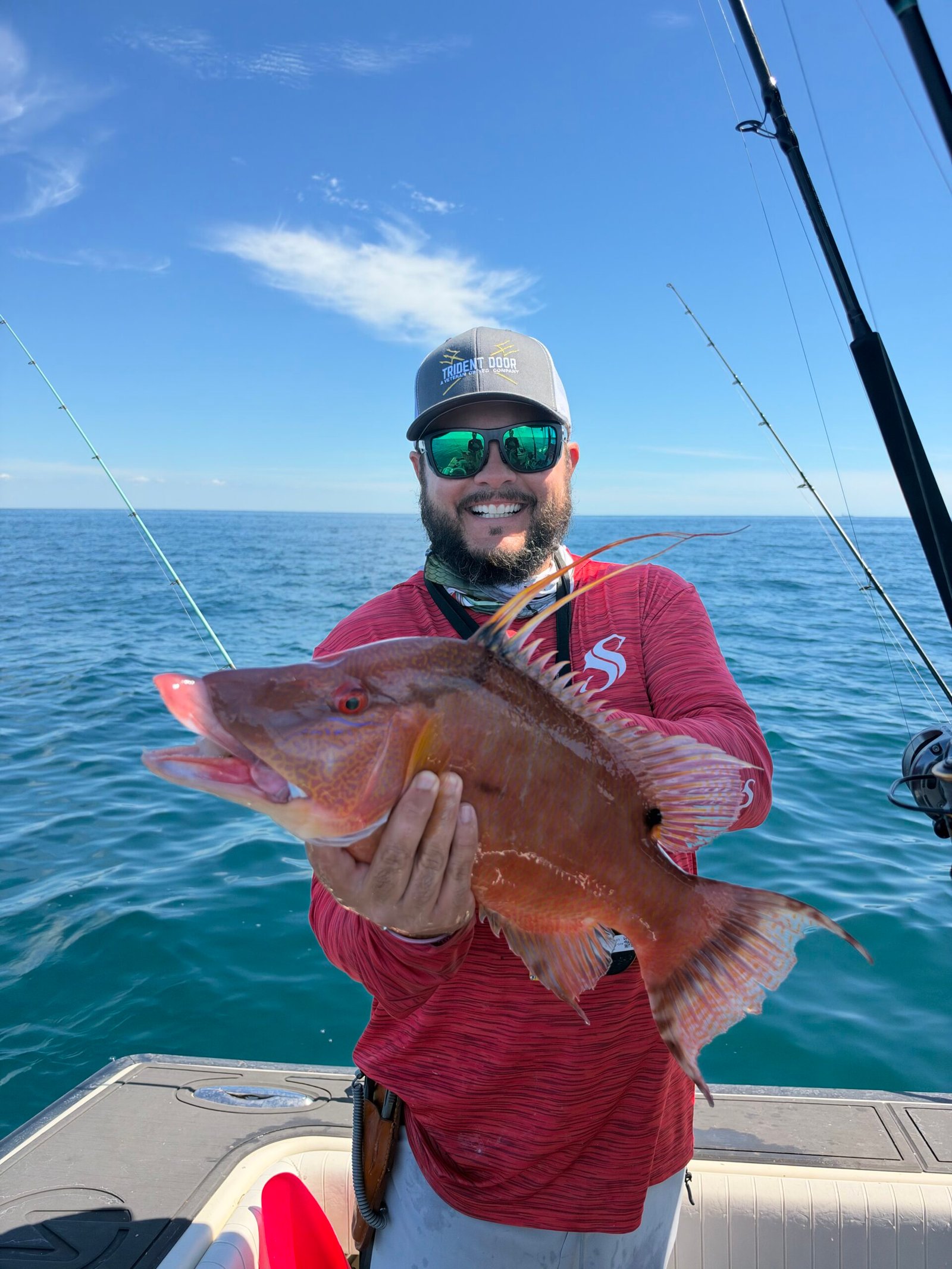
Up came an absolutely gorgeous 23-inch hogfish.
This fish was incredible.
Bright orange and red coloration, beautiful markings, and exactly the kind of hogfish that makes for an outstanding picture—and an even better fish for the dinner table.
Into the box it went.
We continued fishing and caught several more grouper along with some big white grunts, but by this point we were reaching the backside of that major feeding period.
Rather than quit, we continued working our way toward another productive area that I call Hog God.
Two More Keeper Hogfish
The move paid off.
Once we reached Hog God, it didn’t take long before we located more quality hogfish.
We ended up adding two more keeper hogfish, and both fish pulled surprisingly hard.
That’s one thing anglers who haven’t targeted hogfish with hook and line sometimes don’t expect.
They aren’t grouper, but a quality hogfish on relatively light tackle can absolutely put up a great fight.
By this point we had put together an outstanding mixed offshore box, but the Gulf wasn’t finished with us.
Spanish Mackerel Around the Boat
Spanish mackerel were cruising all around us.
With pelagics showing themselves, there was no reason not to take advantage of the opportunity.
We rigged a freelined bait and sent it away from the boat.
That produced several beautiful Spanish mackerel.
Bird was especially excited about those because he enjoys cooking and wanted to smoke the mackerel and make smoked fish dip.
That’s one of the things I enjoy about trips like this.
Not every offshore fishing trip has to revolve around chasing one species all day.
We started in deep water looking at new ledges. We caught red grouper, mangrove snapper, lane snapper, and scamp. We slid shallower and found a 30-inch gag grouper. Then we switched gears for hogfish and finished by taking advantage of Spanish mackerel around the boat.
That’s Florida Gulf Coast offshore fishing.
Offshore Tackle and Technique That Worked
The biggest takeaway from this trip was that you don’t need one heavy offshore setup for everything.
For mangrove and lane snapper around the rubble and pipeline structure, the medium-heavy SRT spinning rods with 4000-size Okuma reels, 15-pound PowerPro, and 20-pound leader allowed the baits to look natural while still giving us enough power to control quality snapper.
A small knocker rig with a roughly 1-ounce weight and 1/0 hook kept everything simple and allowed the bait to stay close to the bottom.
When we moved into serious gag grouper territory, everything changed.
The Tesoro 8000, PCH Custom rod, 50-pound main line, and 50-pound leader gave Bird the stopping power needed to keep that 30-inch gag from getting back into the ledge.
For hogfish, shrimp remained one of the keys.
And when Spanish mackerel appeared around the boat, freelining a bait allowed us to quickly capitalize on fish that weren’t necessarily relating directly to the bottom.
That’s one of the most important offshore fishing skills: adapt to what you’re seeing rather than staying committed to one technique all day.
Fall Offshore Fishing Is Starting to Take Shape
This trip felt like our first real glimpse of fall.
The cooler post-front weather, slightly cooler water, light winds, and active fish were a welcome change from the relentless summer heat.
We caught or encountered mangrove snapper, lane snapper, red grouper, gag grouper, scamp grouper, hogfish, white grunts, and Spanish mackerel while working from approximately 90 feet of water back toward our shallower Gulf spots.
But my favorite part of the trip wasn’t the number of species.
It was Bird finally winning the battle with a keeper gag.
Watching someone catch their first quality grouper—especially after losing several good ones in the past—is what makes these trips memorable.
The 23-inch hogfish didn’t hurt, either.
As Tampa Bay transitions deeper into fall, I’ll continue watching cold fronts, water temperatures, tides, majors and minors, and adjusting our approach accordingly.
If you’re planning a Tampa Bay offshore fishing charter and want to target grouper, snapper, hogfish, and other Gulf species, this is a great time of year to start watching the weather windows.
The fish are there.
Sometimes the biggest challenge is simply making sure you bring enough bait for when they decide to eat.