 Skip to content

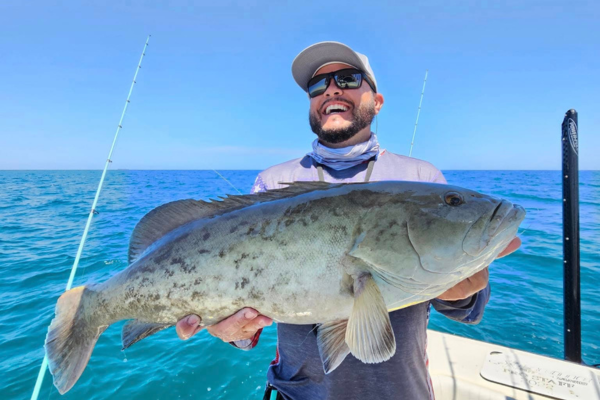
When most anglers think about a Tampa Bay gag grouper fishing charter, they immediately picture running 30, 40, or even 50 miles offshore into the Gulf of Mexico, dropping heavy tackle to the bottom, and spending a large portion of the fishing day traveling.
But here’s something a lot of anglers overlook: you don’t have to run 30 miles offshore to catch a trophy gag grouper.
Tampa Bay is an incredibly unique fishery because we have a wide variety of habitats where gag grouper can take refuge. There are channels, rock piles, natural rocky bottom, bridge rubble, artificial reefs, ledges, deep cuts, and all kinds of structure scattered throughout the bay.
Honestly, I think shallow-water gag grouper fishing is one of the most overlooked fishing opportunities in Tampa Bay.
And when you hook one of these fish in shallow water, you’re going to understand very quickly why I enjoy this style of fishing so much.
These fish pull incredibly hard. Pound for pound, I would put a gag grouper up there with just about anything in the ocean. When you’re catching them around shallow structure, the fight is completely different from dropping down on a grouper in deep offshore water.
There’s no waiting around to figure out what happened.
That grouper eats, the rod doubles over, and the fight is on.
What Makes Shallow-Water Gag Grouper Fishing So Exciting?
One of my favorite techniques for targeting gag grouper inside Tampa Bay is fly-lining or free-lining a big live bait around structure with a large spinning outfit.
There’s something special about fishing for them this way because you’re allowing that bait to naturally work around the structure instead of just dropping a big weight straight down.
And when a gag comes up and eats that bait?
They hit it as if it owes them money.
There really isn’t a better way to describe it.
It’s a violent strike. One second you’re watching your bait swim naturally, and the next second the rod is loaded up and that fish is trying everything it can to get back home.
And that’s where shallow-water gag grouper fishing gets interesting.
A grouper’s first instinct after eating is usually to get right back into whatever rock, ledge, rubble pile, or hole it came out of.
You don’t have a lot of time.
You may have only a few seconds to turn that fish before he gets back into the structure.
If he makes it home, he’s probably going to win.
That’s what makes this completely different from fighting many other fish. You can’t just let a big gag take off on a long run and worry about gaining the line back later.
You need to gain control immediately.
Where Do Gag Grouper Live Inside Tampa Bay?
One of the reasons Tampa Bay can offer such good shallow-water grouper fishing is the incredible amount of habitat throughout the bay.
Gag grouper relate heavily to structure.
Some of the areas we look for include:
- Natural rocky bottom
- Limestone
- Rock piles
- Bridge rubble
- Channel edges
- Artificial reefs
- Ledges
- Hard-bottom areas
- Small isolated pieces of structure
There are also areas containing material from the old Sunshine Skyway Bridge that was placed around Tampa Bay as artificial reef habitat. That type of rubble creates exactly what grouper love: holes, irregular bottom, ambush points, and places to hide.
But the big, obvious structures aren’t the only places I look.
Sometimes a small piece of hard bottom that almost everybody drives over can hold an excellent gag grouper.
That’s where knowing how to read the water and use your electronics becomes extremely important.
Tampa Bay Is More Than Just Rock Piles
The health and diversity of Tampa Bay are another major reason gag grouper can thrive here.
When most people think about Tampa Bay inshore fishing, they picture beautiful grass flats, mangrove shorelines, potholes, oyster bars, and shallow-water species such as snook, redfish, and trout.
Those habitats are important to grouper, too.
Juvenile grouper can utilize these protected areas while they’re small. As the fish grow, they can move toward larger bodies of water, deeper channels, rocky habitat, bridge structures, and ultimately areas that give them access to the Gulf.
Tampa Bay basically gives these fish a huge variety of habitat.
Then you add our deep shipping channels.
There are sections of the Tampa Bay shipping channel that reach more than 60 feet deep, giving grouper access to dramatically deeper water without necessarily having to leave the bay.
That’s one of the things that makes this entire fishery so interesting.
You can go from shallow grass flats to deep channels and heavy rocky structure within the same general ecosystem.
Gag Grouper Are Ambush Predators
Grouper don’t just live around rocks because they like looking at rocks.
The structure provides protection, but it also gives these fish an excellent place to ambush prey.
That’s really what a gag grouper is built to do.
They can sit tight to structure, wait for a pinfish, pilchard, pigfish, threadfin, or another baitfish to get close enough, and then absolutely explode on it.
They don’t need to chase that bait halfway across Tampa Bay.
They use the structure to their advantage.
When you’re free-lining a bait around a good rock pile, and suddenly that gag comes out and crushes it, you’re watching that ambush behavior happen firsthand.
And they do it extremely well.
More importantly, they do it violently.
Why Choose a Shallow-Water Tampa Bay Gag Grouper Charter?
Probably the most obvious advantage is simple:
You don’t necessarily have to make a long offshore run.
I love offshore fishing, but there are days when you’re spending a significant amount of your charter running 30 or more miles into the Gulf.
That requires more fuel, more travel time, and favorable offshore conditions.
When the fish are cooperating inside Tampa Bay, we may be able to target quality gag grouper much closer to home.
That can mean less time riding and more time fishing.
It’s also an excellent option for someone who’s never been offshore before or doesn’t feel comfortable making a long run into the Gulf.
Maybe you’ve always wanted to catch a gag grouper, but the idea of running deep offshore isn’t for you.
This gives you another option.
You can still experience the power of a real gag grouper without necessarily spending hours traveling offshore.
And don’t mistake shallow water for easy fishing.
In some ways, I think these fish can actually be harder to land.
Are Shallow-Water Grouper Harder to Catch?
They certainly can be.
The first reason is pressure.
Some structure inside Tampa Bay is obviously more accessible than a rock pile sitting miles offshore. That means some of these fish have seen plenty of boats, baits, and lures.
You have to be willing to change your presentation.
But the bigger challenge happens once you hook one.
A deep-water grouper may have some distance between where it eats your bait and the structure below.
A shallow-water grouper may only have a few feet.
Think about that.
A big gag eats your bait, and instead of having 20, 30, or 50 feet before reaching its hiding place, that fish may only need to move a few feet before you’re buried in the rocks.
That’s why your reaction time matters so much.
The First Five Seconds of the Fight Are Everything
If there’s one thing I want anglers to understand before coming on a Tampa Bay gag grouper fishing charter, it’s this:
The first five seconds may determine whether you catch that fish.
Once that gag eats, you’ve got to turn his head.
You’re not trying to be gentle with him.
You’re trying to stop him from getting home.
If that grouper reaches the rock, the fight is very often over.
That’s why we use heavy tackle, strong leaders, powerful reels, and rods that can actually put pressure on these fish.
For me, that’s what I call that thump life.
That initial thump, followed by the rod loading up and the fight to keep that fish out of the structure, is what gets me fired up about shallow-water grouper fishing.
Personally, I think it’s more fun than catching them offshore.
Best Time of Year for Shallow-Water Gag Grouper in Tampa Bay
Gag grouper can be found in Tampa Bay throughout the year, but I personally really like the spring and fall patterns.
Fall becomes especially interesting when we start receiving those first couple of cold fronts.
As those water temperatures begin dropping, we often see gag grouper start pushing shallower and farther into Tampa Bay.
When conditions line up correctly, fish can start stacking up around productive structure throughout the bay.
Obviously, no two years are the same.
Florida weather changes. Water temperatures change. Cold fronts arrive at different times and with different intensity.
That’s why I’m constantly paying attention to water temperature and what the fish are doing rather than fishing strictly according to a calendar.
How Water Temperature Moves Tampa Bay Gag Grouper
Water temperature is a major factor in where I look for these fish.
As Tampa Bay cools down, gag grouper can begin pushing into shallower areas.
Then, when temperatures rise, many fish will start transitioning toward deeper portions of the bay, the shipping channels, and eventually Gulf waters.
That doesn’t mean every fish suddenly leaves Tampa Bay on the same day.
Fish don’t read a calendar.
It means we’re adjusting where we look based on the conditions we’re seeing right now.
Tampa Bay’s combination of shallow water, deeper channels, and Gulf access gives these fish plenty of options.
As a captain, that’s part of the puzzle I enjoy figuring out.
Tides and Current Can Make or Break the Bite
If you’re going to consistently catch shallow-water gag grouper inside Tampa Bay, you need to pay attention to the tide.
Current can be one of the biggest factors in grouper fishing.
Personally, I really like transition tides.
When I say transition tide, I’m talking about that period when the tide begins slowing down before changing direction.
Maybe you’ve had a strong outgoing tide, and it’s beginning to slow before turning incoming.
Or maybe the incoming water is losing strength before changing to outgoing.
That window can be excellent.
Why?
Because Tampa Bay can have very strong currents.
When that water slows, grouper can more easily move away from their structure and search for prey without fighting hard current.
That’s when I really like putting a free-lined live bait in front of them.
I’ve seen those transition periods completely change the attitude of the fish.
You can fish an area and know the grouper are there, yet they don’t want anything to do with you. Then that tide begins slowing, the current changes, and suddenly somebody gets hammered.
Timing matters.
Live Bait Is Hard to Beat for Shallow-Water Gags
There are plenty of ways to catch gag grouper, but if I had to choose one approach inside Tampa Bay, I absolutely love live baiting them.
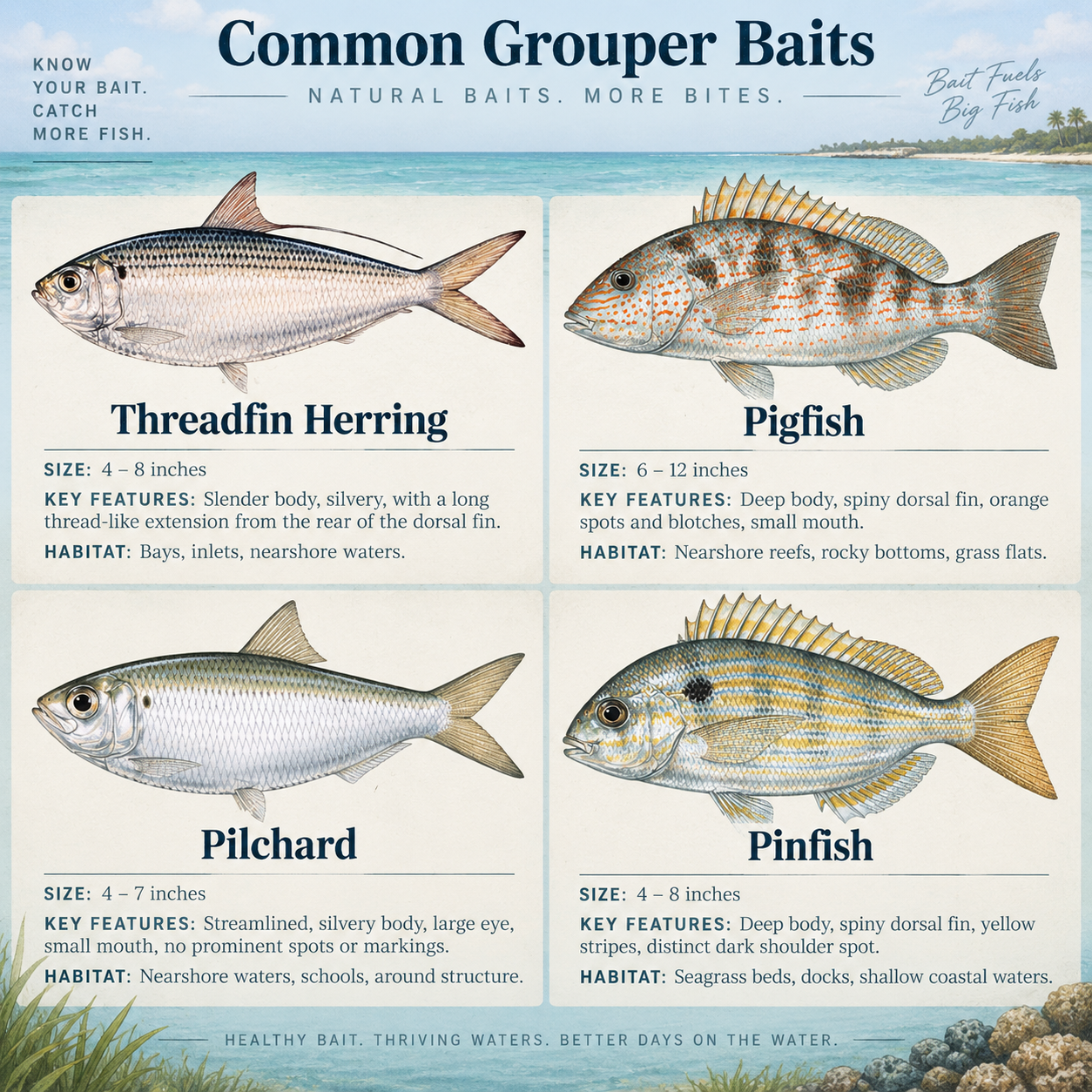
Some of my favorite grouper baits include:
- Pinfish
- Pigfish
- Pilchards
- Threadfin herring
Each one fishes a little differently.
Pinfish and pigfish are great because they’ll naturally try to swim down when they’re free-lined. Around the right structure, that can put the bait exactly where you need it without having to add a bunch of weight.
Pilchards and threadfins can also be phenomenal grouper baits.
Depending on the current, depth, structure, and what I’m seeing, I’ll sometimes use a knocker rig to get those baits down into the strike zone.
The goal isn’t to use one rig every day.
The goal is to present the bait naturally where the grouper are actually feeding.
Free-Lining Live Baits for Gag Grouper
Free-lining is probably one of my favorite ways to catch them because you really get to experience the strike.
Rather than dropping a heavy sinker straight to the bottom and waiting, we’re giving that live bait some freedom to swim.
When you get everything right—your position, current, bait, and structure—the grouper comes out and does what a grouper does.
He destroys it.
That’s one of those fishing experiences that doesn’t require much explanation once you’ve felt it.
The rod tells the story.
Trolling for Gag Grouper Inside Tampa Bay
Live bait isn’t the only way we catch them.
Trolling can be extremely effective for gag grouper inside Tampa Bay, and it’s something I use both to target fish and to cover water.
Deep-diving plugs are one of the traditional ways to do it.
I like plugs capable of reaching roughly 25 to 35 feet, depending on the area I’m fishing.
I’ll troll channel edges, natural rocky bottom, and other productive areas where I believe grouper are holding.
But I also like doing something a little different.
The No. 2 Planer and 8-Inch Grub
One of the presentations I like is a No. 2 planer paired with a large 8-inch grub tail.
I don’t think nearly as many people use this setup as traditional diving plugs, and sometimes doing something different is exactly what you need.
I’ll experiment with different colors, including:
- Chartreuse
- Pink
- White
- Pink and white
- Different combinations depending on water and conditions
I call it split testing.
Don’t decide before you start fishing that groupers are going to eat one particular color.
Put different presentations out and let the fish tell you what they want.
Then once I start seeing a pattern, I’ll adjust accordingly.
What Happens When Grouper Won’t Eat the Plug?
This is where being versatile becomes important.
There are days when I can troll over an area and catch fish immediately.
There are other days when my electronics are showing me exactly what I want to see, but the grouper won’t touch a plug.
That’s fishing.
You have to adapt.
I’ll often use trolling as part of my search process. I’m watching the sonar, looking at the bottom, marking interesting structure, and paying attention to where I’m seeing fish.
If I find a spot that looks right but they won’t cooperate with the trolling presentation, I’ll mark it.
Then I’ll come back and change the program.
That’s when we may put out live pinfish, pigfish, or pilchards.
You would be surprised how often the fish that completely ignored a plug will hammer a live bait.
Sometimes one simple change turns the entire bite on.
Heavy Tackle Is Necessary for Tampa Bay Gag Grouper
Don’t let the words “shallow water” make you think we’re bringing light tackle.
We beef it up.
These fish are powerful, and we’re deliberately hooking them next to the exact structure they’re trying to get back into.
I like using larger spinning reels, including a 5000- or 6000-size Okuma Tesoro, paired with approximately a 7-foot medium-heavy to heavy-action rod.
I’ll typically run 50-pound PowerPro braid with at least a 50-pound leader.
And that’s not always the heaviest setup on the boat.
When we’re around some of the big dogs, I’ll step it up.
I’ll use something like an Okuma Makaira 15 paired with a serious heavy-action rod—what I like to call the meat stick.
Why?
Because when a legitimate gag decides he’s going back into his hole, you’re going to need equipment capable of convincing him otherwise.
This is not the time for questionable knots, worn-out leaders, weak hooks, or a reel with a bad drag.
Grouper will expose every weak link in your equipment.
Using Sonar to Find Overlooked Grouper Spots
Electronics are a huge part of how I fish Tampa Bay.
There are plenty of public numbers and artificial reefs available to anglers.
The problem?
Everybody else has those numbers too.
That doesn’t mean public reefs won’t produce fish. They absolutely can.
But they can also receive a tremendous amount of pressure.
That’s why I spend time searching.
I use both down scan and side scan to find rocky areas, rubble, subtle bottom changes, and small pieces of structure that may not get nearly as much fishing pressure.
You’re not always looking for a giant reef.
Sometimes the spot that holds the fish is surprisingly small.
It could be one rock, a little pile of rubble, or a change in bottom composition that somebody running 30 mph across the bay would never know was there.
That’s part of what good electronics allow us to do.
They help turn something that looks like ordinary water on the surface into a detailed picture of what’s actually happening below us.
Finding Something Other Anglers Overlook
I like finding new structure.
Now, “new” doesn’t necessarily mean nobody in history has ever fished it.
This is Tampa Bay. There are a lot of great fishermen here.
What I want is something less obvious.
I want structure that isn’t necessarily the first public number everybody punches into the GPS Saturday morning.
The less pressure an area gets, the better opportunity we may have to find a fish that hasn’t already seen 20 plugs and 50 pinfish that week.
That can make a big difference with pressured shallow-water grouper.
You Can Even Catch Gag Grouper From Land
Here’s another thing many people don’t realize.
You can catch gag grouper from shore in Tampa Bay.
Certain jetties, piers, and other areas with access to the right structure can hold grouper.
The Sunshine Skyway Fishing Pier is an obvious example because there’s a tremendous amount of structure below and around it.
That allows land-based anglers to encounter these fish without owning a boat.
But if you really want to see what dedicated shallow-water Tampa Bay grouper fishing is all about, that’s where booking a charter gives us the ability to move, search different structures, follow the conditions, and change tactics throughout the trip.
Other Fish We Catch While Targeting Gag Grouper
One of the great things about fishing structure inside Tampa Bay is that you’re rarely fishing around only one species.
The same general habitat can hold a variety of fish, including:
- Mangrove snapper
- Sheepshead
- Spanish mackerel
- Cobia
- Jacks
Depending on the location, season, and conditions, you never know exactly what may show up.
Obviously, the mission on a gag grouper trip is to catch grouper, but some excellent bycatch can add a lot of action to the day.
That’s especially nice when you’re fishing with kids or newer anglers.
Can Beginners Catch Shallow-Water Gag Grouper?
Absolutely.
You don’t need years of offshore fishing experience to come out and catch a grouper.
That’s part of my job as your captain.
We’ll coach you through how to hold the rod, how to present the bait, what to expect when the fish eats, when to apply pressure, and how to keep that grouper moving away from the rocks.
The biggest thing is listening when that bite happens.
It can go from relaxed fishing to absolute chaos pretty quickly.
And when you’re hooked into a real gag in shallow water, you’ll know it.
A Great Grouper Fishing Experience for Kids and Families
I also think shallow-water grouper fishing can be a great way to introduce kids and families to this kind of fishing.
A small child may obviously need help fighting a big grouper.
That’s completely fine.
The advantage is that we may be able to introduce them to grouper fishing without asking the family to start with a long offshore run.
For someone who’s never spent an entire day in the Gulf, that’s important.
We can stay inside Tampa Bay, target real grouper, enjoy a variety of fishing opportunities, and give young anglers a chance to experience just how powerful these fish are.
And when harvest is legal, there’s something special about taking your catch home for dinner.
Grouper is premium table fare, and when you see what fresh grouper can cost at a seafood market or restaurant, catching your own makes the experience even better.
Fishing From My 25-Foot Avenger Custom
When you book a Tampa Bay gag grouper fishing charter with Salty Scales, you’ll be fishing aboard my 25-foot Avenger Custom.
It’s an extremely comfortable platform for both Tampa Bay and Gulf waters.
The boat is equipped with modern electronics that help us find the structure and fish we’re looking for, and there’s plenty of room for anglers to fish comfortably.
It’s also a great setup for families.
You’re fishing from inside the boat rather than spending the entire day balancing on a narrow elevated deck.
For parents bringing younger children, that can provide some additional peace of mind.
It gives us the versatility to fish shallow areas inside Tampa Bay while still having the capability to venture into Gulf waters when the conditions and game plan call for it.
Shallow-Water Grouper vs. Offshore Grouper Fishing
I fish offshore, too, and offshore grouper fishing can be fantastic.
But this is a different experience.
The entire point is that you don’t always have to make that long run to experience quality grouper fishing.
We can catch these fish right here in our backyard.
Tampa Bay has the bait.
It has the habitat.
It has the depth changes.
It has the rocky bottom.
And it has the grouper.
Instead of running deep into the Gulf every single time, we’re taking advantage of a fishery that’s sitting right in front of us.
And again, these fish aren’t somehow easier because they’re in shallow water.
If anything, having the structure only a few feet away can make the fight even more challenging.
That’s what I love about it.
2026 Tampa Bay Gag Grouper Season
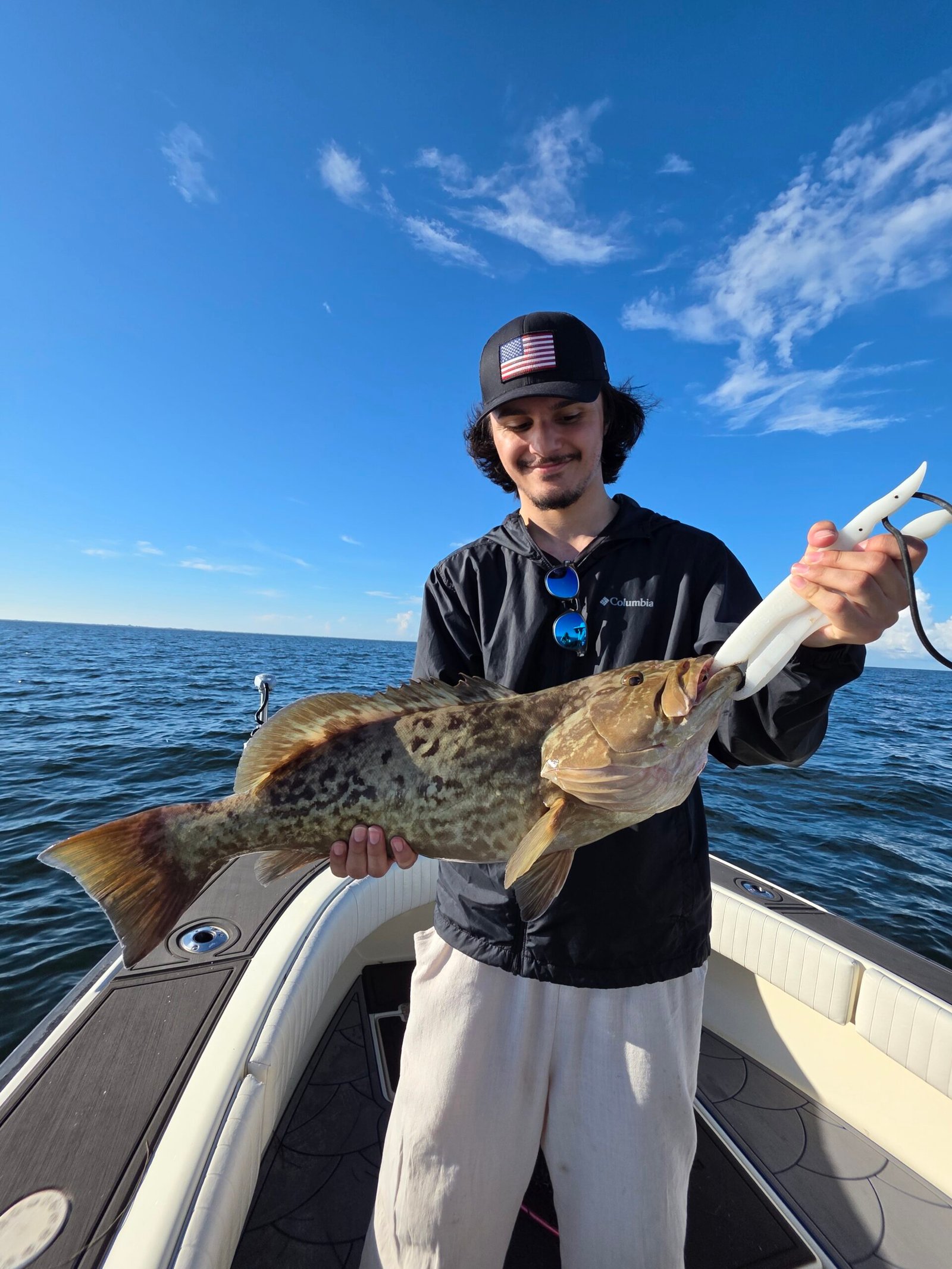
At the time of writing in September 2026, we’re right in the middle of the Gulf gag grouper season.
For 2026, Florida’s Gulf recreational gag grouper season is September 1 through September 30.
FWC currently lists a 24-inch total-length minimum, a two-fish-per-person daily bag limit within the four-grouper aggregate, and zero retention for charter captains and crew. Regulations can change, so always verify the latest FWC rules before fishing.
That short season is another reason I tell people not to wait if catching and keeping gag grouper is on their bucket list.
We only have a limited window to get after them.
Book Your Tampa Bay Gag Grouper Fishing Charter
If you’ve been thinking about catching a gag grouper, this is one of my favorite ways to do it.
You don’t necessarily need a 30-mile offshore run.
You don’t need to spend half the fishing day traveling.
You can experience legitimate gag grouper fishing right here inside Tampa Bay.
We’re going to find the structure, watch the tides, use our electronics, put good bait in front of the fish, and change tactics when we need to.
Maybe they’re crushing deep-diving plugs.
Maybe they want the planer and grub.
Maybe they won’t touch an artificial and we need to free-line a big pinfish right into their living room.
That’s what fishing is all about.
You make adjustments until you figure out what those fish want.
And when that grouper finally eats, you’re going to know immediately.
That rod is going to load up, and you’ve got about five seconds to show him who’s boss.
If you’re ready to experience a Tampa Bay gag grouper fishing charter, reach out to Salty Scales Fishing Charters and let’s get a trip on the books.
We still have a few opportunities during the September season, and I’d love to get you and your family out there.
Let’s put some bends in the rods, get you acquainted with that thump life, and hopefully put some delicious legal gag grouper in the box.
More than anything, I want you to experience for yourself why I think shallow-water grouper fishing is one of Tampa Bay’s most overlooked—and most exciting—fishing opportunities.
Once you’ve had a big gag come out of the rocks and absolutely destroy a live bait in shallow water, I think you’re going to understand exactly what I’m talking about.
Book your Tampa Bay gag grouper fishing charter with Salty Scales Fishing Charters and come see what shallow-water grouper fishing is all about.