 Skip to content

Tampa Bay Tarpon Fishing Charter: A 71-Year-Old Angler’s Bucket List Dream Ends with a Rare Grand Slam
One Dream Fish Turned Into an EPIC day of on Tampa Bay
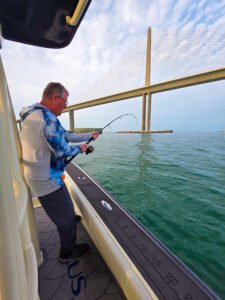
As a fishing guide, I get to meet people from all over the country. Every client has a different story, a different background, and a different reason for stepping onto my boat. Some simply want to catch dinner. Others are introducing their kids to fishing for the first time. Then there are the anglers chasing that one fish they’ve dreamed about their entire lives. Tarpon fishing is the focus on this adventure.
That’s exactly why Paul flew all the way from Rhode Island.
At 71 years old, Paul had spent decades chasing striped bass in the Northeast. He’d caught plenty of impressive fish throughout his life, but one species had always remained at the top of his bucket list—the mighty tarpon.
Known as the Silver King, tarpon are one of the hardest-fighting game fish on the planet. Their blistering runs, acrobatic jumps, and unbelievable stamina make them one of the most sought-after fish in Florida.
Paul wanted that challenge.
He wanted to test himself against a fish that could humble even experienced anglers.
So he booked two days of tarpon fishing with me during July, hoping we’d find one.
By the time the trip was over, he’d not only catch his dream tarpon, but he’d accomplish something very few anglers ever do on a single charter—a true Tampa Bay Grand Slam.
A Picture-Perfect Morning on Tampa Bay
Our morning started long before daylight.
At 5:45 a.m., we loaded up my Avenger Custom by Marauder and eased away from the dock on the Little Manatee River. Summer mornings in Tampa Bay are special. The air is calm, the water is slick, and before sunrise everything feels peaceful.
The conditions couldn’t have lined up much better.
We had light winds, a strong incoming tide, and best of all, I already had a cooler full of fresh threadfin herring waiting for us. Since the bait situation was handled the evening before, there was no need to spend precious fishing time throwing the cast net that morning.
Instead, we pointed the bow toward the Sunshine Skyway Bridge.
As we approached the bridge, the first rays of sunlight began breaking across Tampa Bay. The Skyway slowly came alive against the orange horizon, pelicans started diving, and schools of baitfish flickered across the surface.
It’s one of my favorite places to begin a tarpon fishing trip.
Everything just feels right.
The Tarpon Fishing Action Started Almost Immediately
Once we settled into position, I began chumming heavily with threadfin herring.
One thing I’ve learned over more than three decades fishing Tampa Bay is that a good chum slick attracts just about everything:
- Mangrove snapper
- Gag grouper
- Sharks
- Tarpon
It creates an underwater dinner bell that fish simply can’t ignore.
Only a few minutes into the trip, Paul’s first rod bent over.
After a short fight, he landed a bonnethead shark.
It wasn’t the fish he’d flown 1,300 miles to catch, but it was a great sign. The water was alive.
As I quickly removed the hook and started tying on another leader, I noticed something out of the corner of my eye.
The second rod was slowly bending.
It wasn’t shaking violently like a Spanish mackerel.
Instead, the rod slowly loaded with steady pressure.
I immediately knew.
“Grab that rod,” I told Paul.
He picked it up, reeled down, and the line came tight.
Seconds later…
Tampa Bay exploded.
A 100-Pound Tarpon in the First 10 Minutes
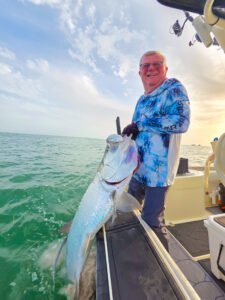 The giant silver fish erupted completely out of the water.
Its massive body reflected the morning sunlight before crashing back into the bay in an explosion of whitewater.
Line immediately began disappearing from the reel.
Paul just stood there smiling.
After years of dreaming about this moment, it was finally happening.
We estimated the fish between 100 and 120 pounds, and we’d only been fishing for about ten minutes.
Sometimes fishing works that way. You spend months planning. You travel hundreds of miles. Then everything changes with one bite.
Forty Minutes That Paul Will Never Forget
Paul was fishing one of my favorite tarpon setups.
An Okuma Soros 6000 spinning reel paired with an Okuma ECS Custom spinning rod.
The reel was loaded with 50-pound braided line, connected to a 60-pound fluorocarbon leader, and finished with a 6/0 Mustad Demon Circle Hook.
It’s a simple, balanced setup that’s landed countless tarpon for both my clients and me around the Sunshine Skyway Bridge.
Unlike many tarpon, this fish spent most of the fight deep below the boat.
Oddly enough, I was perfectly happy about that.
Most anglers love watching tarpon jump, but every jump creates another opportunity for the fish to throw the hook.
Whenever the fish did come to the surface, I reminded Paul to bow toward the fish by lowering the rod tip.
That little move removes pressure from the hook during the jump and dramatically increases your chances of landing the fish.
Around twenty minutes into the battle, I noticed Paul wasn’t talking nearly as much.
His excitement was still there.
But reality had begun to set in.
His arms were burning.
His back was getting sore.
Every pump of the rod took a little more effort than the one before.
Tarpon have a way of finding your limits.
But Paul never quit.
He kept steady pressure on the fish, slowly gaining line whenever the opportunity presented itself.
About thirty-five minutes into the fight, the tarpon finally began circling underneath the boat.
That’s always a great sign.
I eased the Avenger forward to stay directly above the fish and waited patiently.
Finally…
I saw color.
I slipped on my gloves.
Reached over the side.
Grabbed the fish by the lower jaw.
And the hook literally fell out.
We both looked at each other in disbelief.
Forty minutes.
One perfectly timed grab.
One hook that stayed in place just long enough.
Fishing has a funny way of rewarding patience.
Paul leaned over the side of the boat with both hands wrapped around his bucket-list tarpon while we snapped a few quick photos before watching the giant Silver King swim away healthy.
His dream had officially become reality.
Why Stop There? Let’s Chase a Tampa Bay Grand Slam
As incredible as the morning had already been, I looked over at Paul and asked one simple question.
“So… want to try for a Grand Slam?”
He smiled.
Absolutely.
For anglers unfamiliar with the term, a Tampa Bay Grand Slam consists of catching:
- Tarpon
- Speckled Trout
- Snook
- Redfish
It’s an accomplishment very few anglers can honestly say they’ve achieved.
Judging by how the morning had already gone, I felt we had a real chance.
Chumming Up Fresh Bait for the Rest of the Day
With Paul’s bucket-list tarpon successfully released, our game plan completely changed.
Instead of staying around the bridge chasing another tarpon, we shifted gears toward the shallow grass flats.
Before making that move, though, I wanted to make sure we had the freshest bait possible.
We idled over to the Skyway Fishing Pier, where I grabbed my bag of marina fish food and my Dropout cast net.
I’ve been using this technique for years.
A handful of fish food quickly gathers thousands of tiny hatchling pilchards—also known as greenbacks—behind the boat.
Within minutes, the water was alive with flashing baitfish.
One well-placed throw of the cast net completely blacked out the livewell.
Fresh summer bait makes all the difference when targeting multiple species throughout Tampa Bay, and with a livewell packed full of pilchards, I knew we were in great shape for the rest of the day.
The Grand Slam Starts with a Speckled Trout
 Our next stop was one of my favorite summertime grass flats.
The area sits in three to five feet of crystal-clear water with healthy turtle grass, scattered potholes, and plenty of moving water.
During July, these flats consistently hold quality speckled trout, mangrove snapper, and several other species.
It didn’t take long.
On Paul’s very first cast, his cork disappeared beneath the surface.
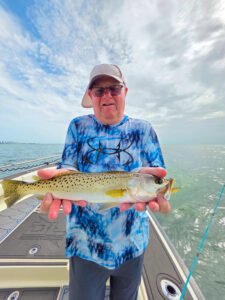
A beautiful 19-inch speckled trout slid into the landing net.
Two species down.
Tarpon.
Speckled trout.
We were officially halfway to completing the Grand Slam.
Over the next thirty minutes, Paul landed five more healthy trout while putting three keeper mangrove snapper into the cooler.
It was one of those mornings where nearly every drift produced another quality fish.
Timing the High Tide for Snook
 As productive as the trout flat was, I knew we couldn’t stay there forever.
The incoming tide was nearing its peak.
That meant one thing.
It was time to find snook.
Anyone who spends enough time chasing snook around Tampa Bay knows just how important water level can be.
High water allows these fish to push farther underneath mangrove shorelines and into areas they simply can’t reach during lower tides.
We made the short run to one of my favorite shoreline systems.
After tossing several live pilchards behind the boat, nervous baitfish started skipping across the surface.
Moments later…
Paul’s line came tight.
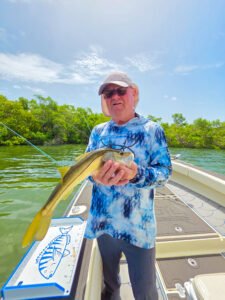
A beautiful snook came boatside.
Three species down.
Only one remained.
The Search for the Final Piece
Now all we needed was a redfish.
If only it were that easy.
Our first stop looked perfect.
Nothing.
The second shoreline had excellent current and bait.
Still nothing.
The third stop gave us hope.
Again, nothing.
Sometimes that’s simply how guiding works.
You trust your instincts.
You stay patient.
And you keep moving.
I looked at Paul and smiled.
“We’re going to find them.”
The Spot That Had Everything
 Our next stop looked like countless others.
A small mangrove pocket.
Clean water.
Good current.
Plenty of bait.
The difference?
This one was loaded.
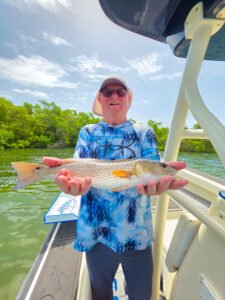
Almost immediately, Paul hooked into a beautiful redfish.
Mission accomplished.
The Tampa Bay Grand Slam was officially complete.
But the action wasn’t over.
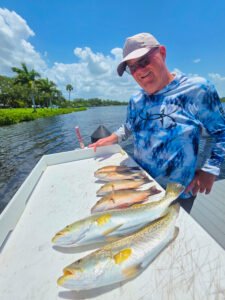
Over the next several minutes we landed another redfish, another snook, and three more keeper mangrove snapper from that single stretch of shoreline.
That’s one of the things I love most about Tampa Bay.
When current, water level, bait, and structure all come together, multiple gamefish often share the exact same piece of water.
A Cooler Full of Fish and Memories
 By early afternoon, the Florida summer heat had settled in.
Throughout the day I intentionally kept the boat positioned along open corridors and the front edges of mangrove shorelines where the breeze could help keep us comfortable.
By around one o’clock, the mangrove snapper bite slowed considerably, just as it often does during the hottest part of a July afternoon.
Fortunately, there wasn’t much left to prove.
Paul had accomplished everything he’d traveled to Florida hoping for.
✔ Bucket-list tarpon.
✔ Tampa Bay Grand Slam.
✔ A limit of mangrove snapper.
✔ Multiple keeper speckled trout.
✔ Memories that would last a lifetime.
Back at the Little Manatee River, I cleaned the fish, washed down the Avenger, and packed Paul’s catch before sending him back to his hotel to relax.
I was headed to ICAST.
Paul had earned a well-deserved day of rest before we met back up for Part Two of his adventure.
Why July Is One of Tampa Bay’s Most Underrated Fishing Months
Many anglers overlook July because of the heat, but they’re missing one of the most diverse fisheries of the year.
Tarpon continue patrolling the Sunshine Skyway Bridge.
Speckled trout thrive across the grass flats.
Mangrove snapper stack up around bridges and structure.
Snook feed aggressively on high tides.
Redfish cruise mangrove shorelines throughout the bay.
When you put those opportunities together, July offers anglers one of the best chances all year to catch multiple trophy species in a single day.
Book Your Tampa Bay Fishing Charter
Every charter tells a different story.
Sometimes it’s a child’s first fish.
Sometimes it’s a family making memories together.
And sometimes it’s helping a 71-year-old angler accomplish a dream he’s carried for decades.
Watching Paul cradle his first tarpon before releasing it back into Tampa Bay is something neither of us will ever forget.
Completing a rare Tampa Bay Grand Slam simply made the day even more unforgettable.
If you’re ready to chase your own bucket-list fish or experience everything Tampa Bay has to offer, I’d love the opportunity to put you on the fish.
Visit SaltyScalesCharter.com today and let’s create your next unforgettable fishing story. Checkout this short video of Paul catching his NEW PB: